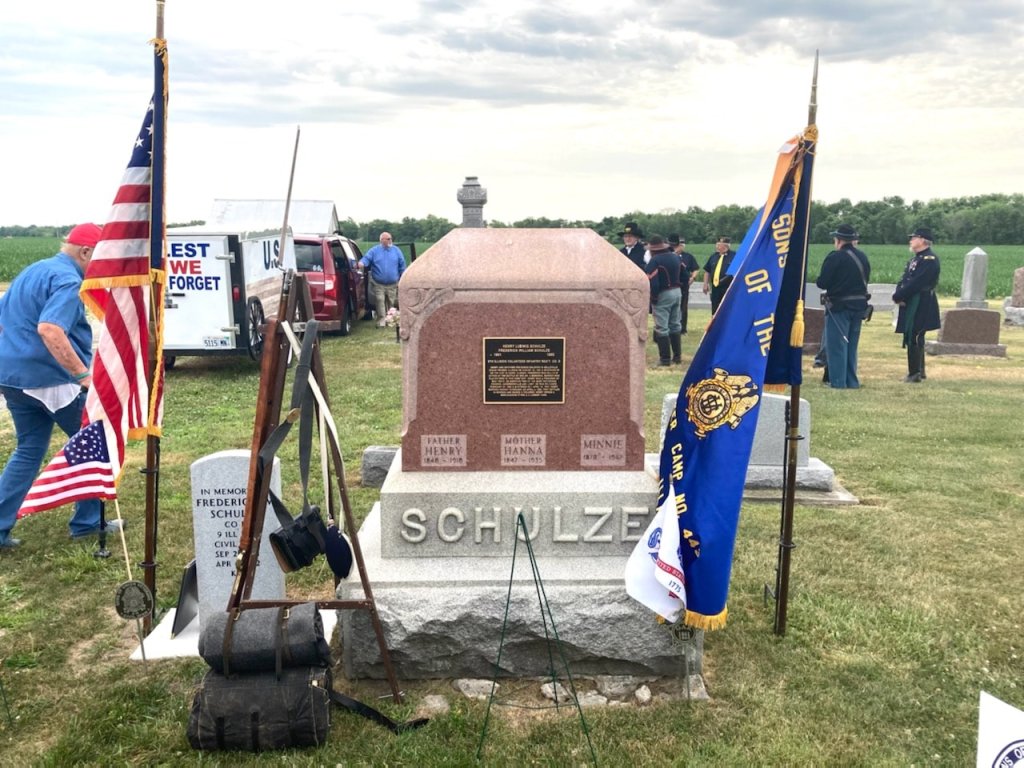
Editor’s Note: The following is the speech prepared by and given by Brother Steve Schulze during the dedication of the grave markers for his relatives.
My name is Steve Schulze. I’m a great-grandson of Henry Schulze, one of the men who we commemorate today. I want to thank everyone who has come out this morning, especially those who are descendants of Henry and Hannah. Welcome to all my cousins and their families.
I would like to introduce you to my great-grandfather. Henry Ludwig Schulze who was born on Jan. 27, 1840 in the town of Isenstedt in Westfalia, Prussia. He was the third of eight children of Cord Heinrich Schulze and Sophia Charlotte Vinke. He was well educated for the time, graduating from a “Gymnasium” or high school.
Henry and his brother Frederick emigrated to the U.S. in 1857. He later said his father had sent his children to the U.S. for religious liberty. They borrowed enough money to pay for their passage, and in September 1857, they sailed from the Port of Bremen (today Bremerhaven) on a ship named the Anna Deluis, bound for New Orleans, Louisiana. After a two-month voyage, the Anna Deluis arrived in New Orleans on Nov. 6.
Henry and Frederick then traveled by steamboat from New Orleans to St. Louis, Missouri. They crossed the river into Illinois, working as farm hands in Madison County for $5 a month. In 1858 they moved to Ridge Prairie where they continued to work as farm hands.
Henry and Frederick enlisted together in the Union Army at Cairo, Illinois on Aug. 18, 1861. They were formally mustered in as privates in Company D, 9th Illinois Volunteer Infantry on Aug. 31.
Henry was described as being 21-years old, 5 foot 7-1/2 inches tall with grey eyes and light hair. The documentation I received on Frederick from the National Archives was, unfortunately, very sketchy and did not include a description.
The 9th Illinois was part of the Western Union Army. On Feb. 6, 1862 Henry and Frederick took part in the attack on Fort Heineman in Tennessee. In order to reach the fort the regiment had to wade through the icy water from the flooded Tennessee River. Henry contracted rheumatism from which he never fully recovered.
Henry and Frederick also participated in the attack on Fort Donelson. After the fort was taken, Henry was sent to the military hospital at Fort Henry near St. Louis. He returned to his regiment in March 1862.
The 9th Illinois fought at the battle of Shiloh in Tennessee. On the first day, April 6th, the regiment occupied a key position at the center of the Union line. The regiment bore the brunt of the Confederate assaults for eight hours. According to regimental records the regiment mustered 602 officers and men present at the start of the battle. Eight hours later only 297 men remained. Among the fallen lay Frederick Schulze.
A headstone for Frederick was placed here in the Worden Lutheran Cemetery after the end of the war. Church records don’t show whether his remains were actually reinterred here of if the stone was simply a memorial marker. I found the headstone still standing when I visited the cemetery in 1968 when I was 20. However, it has since collapsed.
Today, we are commemorating a new memorial headstone for Frederick that has been installed here next to Henry and his family.
Nearly a year after Shiloh, in March 1863, the regiment was consolidated with other decimated units and mounted on mules. The regiment fought as mounted infantry for the remainder of the war.
POW
Henry was captured twice during the war. He was first captured on April 17, 1863 during a battle at Cherokee, Alabama. He was imprisoned in Libby Prison in Richmond, Virginia for ten days from April 26 to May 5, 1863. He was released on parole at City Point, Virginia until he was properly exchanged. He rejoined his regiment in June 1863.
Henry was captured a second time on the Flint River near Decatur, Alabama on March 21, 1864. According to the story Henry later told my grandfather John, he was riding a mule while scouting, when he suddenly came upon a Confederate patrol. He turned his mule around and rode away with the Confederates in pursuit. When he came to a fork in the road he tried to go to the right. The mule disagreed, and jumped into some scrub trees on the side of the road. Henry and the mule were both caught in the branches until the Confederates pulled them loose.
As the war dragged on, the emphasis had shifted to total war. In March 1864, General Grant ordered an end to the practice of paroling prisoners until they were exchanged. As a consequence, Henry remained a prisoner of war from March 21, 1864 until his release at N.E. Ferry, North Carolina on February 27, 1865. He was held for six months in Andersonville Prison in Georgia. When Andersonville was closed he was transferred to another prison in Florence, South Carolina.
Henry later told his son John about the hardships he endured at Andersonville. The following account is from a letter my grandfather wrote to my brother Russ.
“The men had very little to eat. They would trade a little tobacco for some flour so they could bake some bread, then trade a little baking powder for something else. Sometimes some of the men would steal from their comrades. Once, four or five were caught. A trial was held, and they were sentenced to be hanged. It was done to teach the others a lesson. All the prisoners must have suffered terribly.”
Henry contracted dysentery in Andersonville and suffered periodic bouts of the disease for the rest of his life.
According to the records retained in the National Archives, Henry was discharged on April 14, 1865 in Springfield, Illinois. He returned to St. Louis where he stayed with the Lueckers. He worked at various jobs on farms in the surrounding area.
In 1868 Mrs. Luecker introduced Henry to Johanna Siebrasse. Johanna was born in Bielefeld, Westfalia on May 17, 1847. She had come to America as a “marriage bureau bride” in order to meet and marry a “man with a farm.” She had a good education for a girl of middle class parents, and had been a weaver of damask for the royal house of Prussia. The marriage was arranged through Mrs. Luecker.
Henry and Johanna were married after the first service on Sunday, April 4, 1868 in St. John’s Evangelical Church located at 14th and Madison St. in St Louis. Witnesses included Freidrich Ebmeier and Henry’s brother Johan Friedrich Schulze.
For the next eleven years Henry and Hannah worked on a farm about three miles south of Worden. In 1879 they purchased a 196-acre farm approximately 1-1/2 miles south of Worden. They worked this farm for four years. In 1883, Henry sold the farm and purchased a general store in Worden. He later became part owner of a lumber yard. Worden was a town of about 500 people in 1890.
By 1910 the village had grown to a population of over 1,100. Originally called New Hampton, the town was renamed in 1870 when the Decatur and East St. Louis Railroad was built through the town. The railroad named the station for station master John C. Worden, an Englishman who also had real estate and other business holdings in the area. In the late 1800’s the town’s principal businesses were the lumber mill and two coal mines. The town had a two-story city hall, two-story school, and four churches; Baptist, Methodist, Lutheran and Christian.
Henry and Johanna lived in a home on the second floor of the general store for a number of years. They raised their children in that residence. Henry later built a two-story house with a porch across the front a few blocks away on the corner of West Kell St. and North Lincoln St.
Their home still stands today. Henry and Hanna raised eight children. Minnie, the eldest, who suffered from epilepsy, continued to live with her parents as an adult.
Minnie is buried here (in Worden) next to her parents. There were three other girls; Mary, Anna and Sophia. There were four boys; William, Henry, Adolph and my grandfather John, who was the youngest.
The Schulze family were members of the Piatist Lutheran sect. This group followed very strict rules. No one was allowed to use phrases like “By Golly” or “Gee-Whiz.” Church attendance was mandatory. All women wore black dresses when they went to communion. The hats of the women were removed before going to the communion rail, so the front pews were reserved as a repository for the hats. When girls were confirmed they would wear black dresses until their 18th birthday. All pianos were instruments of the devil. However, when Sophia, who was her mother’s favorite daughter, wanted a piano, the family got one for her. She was also permitted to take voice lessons.
Henry was the model for the typical general store proprietor of the late 19th century. The store was the center of activity for the community. His granddaughter wrote about her memories of going into the store and finding Henry sitting with his feet propped up on a chair with all his friends sitting there chewing the fat around the pot-bellied stove…
…Henry was a staunch Republican who was active in local politics. He served as Village President from 1897 to 1898, and his name is included on a plaque on the old city hall building.
The family were also active in the affairs of the community. A photo from the early 1900’s shows that Henry and his sons Adolph, John and William were members of the Worden Brass Band.
Henry passed away on the morning of June 26, 1910. He was buried here at the Cemetery on June 28, 1910, followed by his wife of 42 years in July 1935. All his living siblings, as well as a couple dozen grandchildren attended her funeral. His daughter Minnie followed in October 1947. I was two weeks old when she passed away.
I like to think Henry and Hannah would be pleased to see how their children and their descendants have fared. They would want to know about the lives the members each generation have lived, the things they have done and the places they have seen. I’m sure Henry would be interested in the fact that the house he built still stands and is about to be converted for a new and useful purpose. Most of all, I think he would be pleased to see how the people who live here
today are working to keep this town alive and vibrant.
 heckercamp443
Leave a comment