By Gerald Sonnenberg, USAF retired
Hecker Camp #443 Secretary
It seems fitting that this month we celebrate Thanksgiving, as well as our Veterans. In doing so, we take the time to remember and be thankful for the service and sacrifice so many have made throughout our history. No matter their job, the mission or the sacrifice involved, Veterans give all to defend this Nation. Today, the care our wounded warriors receive is top of mind. And while recovery from Post-Traumatic Stress Disorder (PTSD) and other physical and emotional wounds are addressed now, it wasn’t so much 150 years ago.
During the Civil War, estimates are that 620,000 to 750,000 Americans died during the war; mostly from disease. The wounds suffered by soldiers at the hands of the enemy, as well as crippling disease were staggering. And the combination of improved military technology and outdated military tactics at the time created large numbers of “wounded warriors.” Depending on the severity of their wounds, troops were often discharged if they survived their hospital stays. There is little documented evidence of any type of rehabilitation back then, as many of those troops were rendered unable to actively participate in field duty because of wounds, disease or age, but still had time left on their enlistments. Otherwise, what could be done with what some people referred to as “hospital bummers.”
Soldiers deemed fit enough had been used as nurses, cooks or hospital attendants since 1862. In 1863, an organization was created, partially, to address the desire to help soldiers continue to serve honorably in uniform and feel useful, as well as to address the need for more troops on the frontline. On April 28, 1863 the United States Army created the Invalid Corps for those troops still fit enough for garrison or light duty. The name officially changed to the Veteran Reserve Corps (VRC) in March 1864. According to the National Archives, the Corps consisted of companies and battalions “made up of
- officers and enlisted men unfit for active field service because of wounds or disease contracted in the line of duty, but still capable of performing garrison duty
- officers and enlisted men in service and on the Army rolls otherwise absent from duty and in hospitals, in convalescent camps, or otherwise under the control of medical officials, but capable of serving as cooks, clerks, orderlies and guards at hospitals and other public buildings
- officers and enlisted men honorably discharged because of wounds or disease and who wanted to reenter the service.” (U.S. National Archives, 2010)
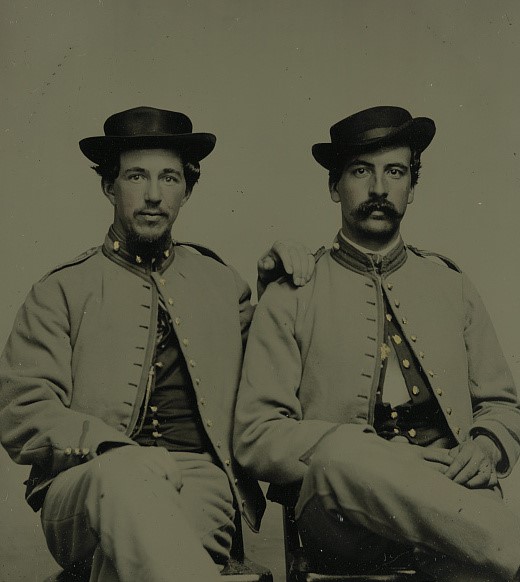
For many of those “assigned” to the Corps because of time left on their enlistments, there was a negative stigma of being a part of it, especially for those who wished to rejoin their regiments. In fact, a primary reason for the name change from Invalid Corps to Veteran Reserve Corps wasn’t the use of the word “invalid;” it was confusion with the acronym I.C. (inspected-condemned), which affected volunteer morale. The uniform colors also affected morale to a point. At the time, the standard Army uniform consisted of sky-blue pants and a dark blue jacket or frock. The VRC uniform was primarily sky-blue pants and jacket or frock with dark blue trim. This was a negative aspect for those who preferred to not stand out in such a way and be thought of as regular Army.
About 60,000 soldiers served in the VRC, organized into a division of 24 regiments and included two battalions. The first battalion contained those more physically able. The Second Battalion was smaller and made up of men whose disabilities were more serious, such as lost limbs. These men were typically employed as cooks, orderlies, nurses or guards in public buildings.
The Veterans of the VRC proved themselves in a variety of ways. In addition to working in hospitals and kitchens and guarding prisoners and public buildings, they enforced the draft, guarded railroads and even played a pivotal role in the defense of Washington D.C. in July 1864 during Confederate General Jubal Early’s raid against Fort Stevens outside the capital. Twenty-four members of the VRC died in combat, and four members from Company F of the 14th Regiment conducted the gruesome work of executing the four conspirators convicted in the assassination of President Lincoln by knocking out the post that released the platform.
The VRC continued until the reorganization of the regular Army reduced it to just four regiments in 1866. These last four regiments were absorbed into the regular Army during the next reorganization in 1869.
Whether they knew it or not at the time, these Soldiers served their country as proudly as any other unit; regardless of the color of their uniform or their physical status. They shouldered the duties thrust upon them by the horrors of war and helped the Union defeat the Confederacy; thereby unifying the Nation. Our wounded warriors were heroes then as they continue to be today; examples of courage and victory over adversity.
Other references:
Sarah Handley-Cousins. “Wounded Warriors.” The Civil War Monitor, Fall 2020, pages 26-28.
Kayla M. Pittman. “From Invalid Corps to full active duty: America’s disabled soldiers return to war.” National Museum of American History, July 14, 2015, https://americanhistory.si.edu/blog/invalid-corps-full-active-duty-americas-disabled-soldiers-return-war
 heckercamp443
Leave a comment