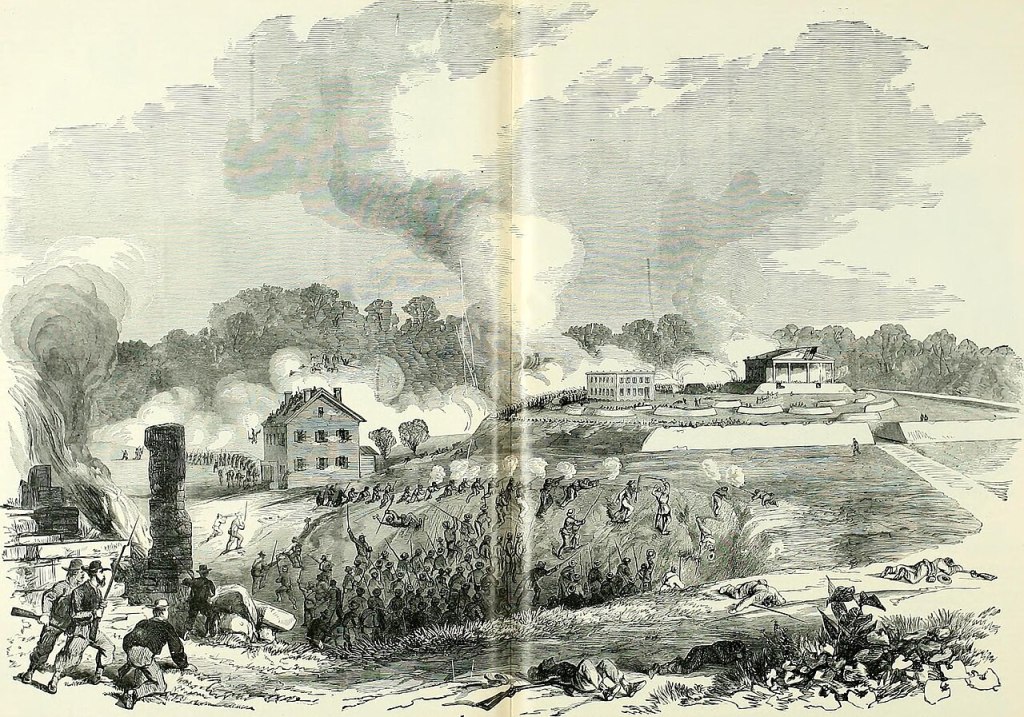
(Above) An engraving of the Siege of Lexington. (Courtesy image)
By Gerald Sonnenberg
Hecker Camp secretary, editor
While the fame of Irish units like the 69th New York is well known in Civil War circles, other states had their own “Irish Brigades.” In Illinois, it was the 23rd Illinois Volunteer Infantry Regiment; the “First Irish,” whose first battle is probably their most famous.
The 23rd Illinois Infantry was raised by attorney James Adelbert Mulligan and organized at Chicago, Illinois. It was mustered into Federal service on June 15, 1861. They were moved to Quincy, Illinois, July 14, then to St. Louis, Missouri, and finally, to Jefferson City, Missouri July 21 until Sept. 8.
Led by, now, Col. Mulligan, the regiment was then marched to Lexington, Missouri in the northwest of the state to counter the pro-Confederate Missouri State Guard under Sterling Price fresh off his victory over Union forces under Brig. Gen. Nathaniel Lyon in August at Wilson’s Creek.
The 23rd was then joined by a detachment of the 27th Missouri Mounted Infantry under Lt. Col. Benjamin W. Grover. On Sept. 11, the 13th Missouri Infantry and Maj. Robert T. Van Horn’s battalion returned to Lexington. Mulligan now commanded 3,500 men. However, the 23rd and the rest of the defenders were besieged and attacked by Price’s army, which was five times their size.
After a week, the siege of Lexington, also known as the first battle of Lexington or the battle of the Hemp Bales ended with Mulligan’s surrender.
After being paroled, General John C. Fremont (commanding the Department of Missouri) had the 23rd Illinois mustered out of service, but in December General George McClellan (then supreme commander in chief of all Union armies) had it restored.
After being reconstituted, the regiment left camp in the spring of 1862 for western Virginia, where it spent most of the rest of the war. However, just like at Lexington, the 23rd fought courageously in more than a dozen battles and other actions.
In May 1864, the unit joined Gen. Philip Sheridan’s army in the Valley Campaign. Several battles occurred during this campaign, and one of them, the Second Battle of Kernstown, happened on July 24. This fight claimed the life of Col. Mulligan when he was shot by a Confederate sniper as he stood up in his saddle to spur his men on. Mulligan’s soldiers endeavored to carry him to safety, but the unyielding Confederate fire made this an impossible task.
Mulligan was well aware of his situation, and the danger his men were in, and so he famously ordered, “Lay me down and save the flag.” Mulligan’s men reluctantly complied. Confederate soldiers captured Mulligan and carried the mortally wounded colonel into a nearby home, where he died two days later, July 26, 1864. He was later buried at Calvary Cemetery in Evanston, Illinois.
At the end of 1864, the 23rd headed to the Richmond area, led by Lt. Col. Samuel Simison, for the Siege of Petersburg and was present at Lee’s surrender at Appomattox.
In all, the regiment suffered four officers and fifty enlisted men who were killed in action or who died of their wounds and two officers and ninety-three enlisted men who died of disease, for a total of 149 fatalities.
 heckercamp443
Leave a comment