“Koerner Regiment”
By Jon Stacy, Camp Historian
The 43rd Illinois was recruited throughout the state, to include Chicago, Peoria, Quincy, Rock Island, Galesburg, Springfield and elsewhere from principally Immigrant & First Generation German-American’s, the largest core group of the Regiment came from St. Clair County. All three of it’s Commanders came from this region (Raith, Engelmann & Dengler).
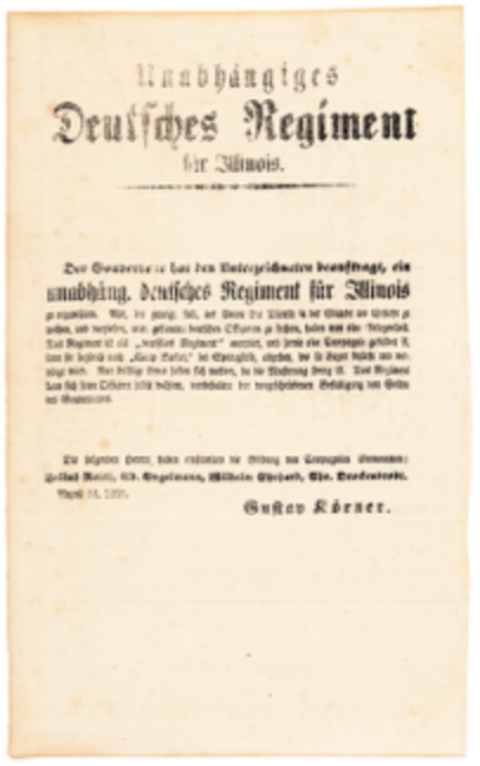
Recruiting Poster for the “Unattached German Regiment for Illinois”
The idea of the Regiment was that of Gustav Koerner, and he sent a letter, on 24 July 1861 to Senator Trumbull and President Lincoln, asking for permission to form an “All German Regiment”. However, the red tape of Washington DC, prevented a quick answer and many of the dissatisfied soldiers who left the 9th Illinois (after their three-month enlistment), joined the 12th Missouri, under Peter J. Osterhaus. Koerner seeing many a good soldier join Missouri Regiments, appealed to Governor Yates who immediately accepted his idea as part of the second call of troops. Once permission was granted, Mexican War veterans Captain Julius Raith and Lieutenant Adolph Engelmann (who was the brother in law of Koerner) were some of the first to enlist, and became very instrumental in recruiting area Germans into war service. Koerner was successful in getting seven companies of men to Springfield by September 1st, 1861. Colonel Julius Raith was the regiment’s first Commanding Officer, as appointed by Governor Yates, but the unit would name itself the “Koerner Regiment“.
They were initially armed with Harper’s Ferry & English Tower muskets that were remanufactured from flintlock to percussion muskets. The 43rd Illinois would initially be sent to quell the Confederate uprising in Missouri, serving briefly in Otterville & Tipton, Missouri. Before departing Missouri the 43rd was fulfilled with their last two companies and they were rearmed with Belgian rifles that were excellent weapons, but a heavy one. In February 1862; the regiment was eight hundred strong, and embarked aboard the steamer Memphis for Fort Henry, arriving on 6 February. They were immediately assigned to the third brigade in McClernand’s Division, in Grant’s Army of West Tennessee.
By the end of the month, they occupied Ft. Henry for two days, during the Battle of Fort Donelson, Tennessee; before heading for Savannah, Tennessee; onboard the steamer Eugenie arriving there on 3 March, 1862. The 43rd was sent to join Grant’s main army at Pittsburg Landing, linking up with them on 22 March, 1862. Here they were attached to the 1st Division under the command of Major General John A. McClernand, with Colonel Leonard Ross in command of the 3rd Brigade. The 43rd was attached with the 17th, 29th & 49th Illinois. The 43rd was bivouacked near and to the northeast of the Shiloh Church.
During this time, the Division Commanders (all Brigadier Generals) were squabbling about seniority, with General McClernand being one of the big ones. Lieutenant Colonel Engelmann wrote his wife, and advised her not to place a division number on her mail to him. Also during this time, Colonel Raith penned a letter to Gustav Koerner…
”I expect some political capital was made of our being left behind at Fort Henry; but we have all got reconciled to being left, as there was rather considerable militia general- ship displayed there; and as none of us belong to the mutual admiration society we should have got but little credit, if we had done anything. I am afraid Papa Lincoln is making generals too fast. If the war lasts much longer, some of them he has made will last no longer than the next general engagement. Some of them have at least sense enough to keep military men as their aides. We are encamped about eight miles above Savannah, Tenn., on the west side of the river, in very fine timber. There must be at least 60,000 troops here. The camp talk is that we shall wait here until Buell comes up with his command. The health of the men is getting better. It was rather bad as long as we were on the boats. We are in very good spirits and as harmonious as ever, and keep the men in first rate discipline; and they all feel comfortable and proud in comparison with some of the regiments around us. Give my respects to all inquiring friends. ”Yours respectfully, ”J. Raith.”
In the days leading up to Sunday, 6 April 1862; many regiments on the southern edges of the Pittsburg Landing camp ground could hear the rustling of leaves as Rebel scouts surveyed the landscape, and on more than a few occasions spotted them in the dense wooded area. It was stated that there were no end to the tents, and stretched as far as the eye could see
Early in the morning on 6 April 1862; around 7 AM, Colonel Raith realized the threat after hearing small arms fire in the distance to the southwest towards Sherman‘s Division, in Fraley Field, he instructed Lt. Colonel Engelmann to notify General McClernand of the approaching enemy and battle was imminent. Raith instructed the regiment to strike their tents, wagons loaded and form a color line. The 43rd formed its color line prior to 7:30 AM.
When Engelmann returned he was instructed to inform Colonel Reardon (of the 29th Illinois) to command the 3rd Brigade in Colonel Ross‘s absence (he was on furlough), but Colonel Reardon was out sick & unable to command, so the Brigade command fell to Colonel Raith. As Raith immediately instructed Engelmann to turn out the 49th Illinois, the enemy was approaching. Engelmann found that the 49th didn’t believe that the enemy was as close as he said, and returned to their breakfast. The arrival of wounded and panic stricken Federal troops entering the bivouac of the 3rd Brigade, changed all that, but the men of the 49th had barely enough time to grab their muskets and accruements before they entered the fight, as they didn’t form a line, to counter the Confederate surprise offensive. One fortunate item was in the favor of the defending soldiers, is that their camp was mainly concealed by a heavy wooded area, which bought additional time. By getting the men of the 49th up and ready, Raith’s actions saved many additional lives that day, as the men of the 3rd Brigade, 1st Division of the Army of the Tennessee put up a staunch defense, the 43rd Illinois were the only regiment ready for action, that fateful morning.
Colonel Raith however found himself commanding a brigade by himself without any aides, or mounted orderlies to disseminate his orders. The Rebels burst onto the battlefield, in large numbers with “terrific yells”. The initial shock of the oncoming Confederates pushed the 3rd Brigade back into a makeshift line, that supported Sherman’s Left Flank
By 8 AM, with Engelmann in command of the 43rd would push forward and held it’s line supporting Waterhouse’s Battery (Company E, 1st Illinois Light Artillery). The 53rd Ohio which had just arrived, was ahead of the 43rd & 49th Illinois (to the left of the 43rd) and being faced with the onslaught of Confederate attackers, ran through the Illinois lines and could not be rallied, nor were they seen for the remainder of the day. One soldier of the 43rd later remarked that the Ohio troops “came near getting shot by our boys”, as they witnessed Sherman’s left flank disintegrate. Colonel Jesse Appler (53rd Ohio Infantry), was seen sitting behind the line of the 43rd Illinois in near hysterics.
Colonel Raith found himself up against Confederate Brigadier General Patrick Cleburne, who concentrated his assaults against Raith’s Brigade (and the Brigade of Col. Ralph Buckland), which were repulsed with heavy losses. Unfortunately for Colonel Raith, Colonel Jesse Hildebrand’s Brigade had all but disappeared (which consisted of the 77th Ohio, as many men fled and those that remained were decimated), but Hildebrand held his ground alongside Raith, despite the considerable losses he sustained.
The regiment held it’s line until 10 AM, when it was forced back with the Division to Purdy Road. After abandoning the Waterhouse Battery, the Confederate soldiers were quick to turn the three pieces of artillery around and use them against their former owners. Here at Purdy Road, Colonel Raith was shot in the thigh and mortally wounded by a minie ball. After the wounding of Colonel Raith, the brigade command fell to Lieutenant Colonel Enos P. Wood, of the 17th Illinois Infantry
The 43rd Illinois held their ground at Purdy Road and bought time for the center of the Union line was formed in a wooded area, now known as the “Hornet’s Nest”. With the Confederate Army entangled with soldiers under the command of Brigadier General Benjamin Prentiss.
Colonel Engelmann didn’t receive any orders to fall back and stubbornly held their ground until the Confederate army finally broke their lines. The 43rd Illinois found themselves surrounded as they fell back, many soldiers were either out of ammunition or close to it, but they found a hole and fought through it, taking heavy losses in the process. The majority of those lost by the 43rd Illinois were in this engagement, and lost forty-three in the process. Those forty-three were later buried in a single trench. The time was 11:20 AM
Under the command of Lt. Colonel Adolph Engelmann, the regiment would continue to fight as they were pushed back by the Confederate Army, to the west of the main fighting in the “Hornet’s Nest”, as they cart wheeled to the north and then the northeast, under the direct orders of General W.T. Sherman. Continuing to fight through the thick timber, for most of the afternoon against the pushing Confederate attackers, they ended up in Jones Field, and formed a line east of the lane, which was reinforced by the survivors of the 9th Illinois, around four that afternoon. It was here that the 43rd absorbed the final shock of Rebel attackers.
At the end of the first day of fighting they found themselves on Grant’s final defensive line to the northeast of their original position, along the Hamburg & Savannah Road. The 43rd Illinois linked up with the 20th & 46th Illinois, around 4:30 that afternoon in the camp ground of the 9th Illinois, when they were inspected by General’s Sherman and McClernand. That night many of the men fell slept on the ground in the rain and mud, as the day‘s events left them completely exhausted. The 43rd faced the west, and held their position throughout the night. It was noted by General McClernand that both Colonel Raith & Engelmann commanded with “coolness, courage and skill”.
It was also noted that in every position that they held during the day, they were forced to leave their dead and seriously wounded comrades lay where they fell. The wounded were carried off by Confederate soldiers, and would be the only men reported missing.
On second day of the engagement, only 150 men of the 43rd were available for action, as Federal forces slowly pushed the Confederate‘s off the battlefield and to the south in a steady motion, taking back the same ground that was painfully taken from them the day prior. The 43rd Illinois fought under the command of Col. C.C. Marsh of the 20th Illinois Infantry. With the Confederate Army in full retreat to Corinth, the 43rd bivouacked in their original site at the end of the day, around 4 PM, as the men were completely exhausted after two days of fighting. The 43rd’s losses in the Battle of Shiloh, were heavy, (entering the engagement with 525), 5 Officers killed & 7 Wounded. The Enlisted suffered with 45 men killed and 111 wounded. Nearly a quarter of the soldiers in the 43rd were either killed or wounded in the battle.
It was found, that troops under the command of Confederate Brigadier General Sterling A.M. Wood, raided their supplies and liberated eight pounds of the best swiss cheese, as well as four pounds of chocolate, along with sauerkraut. To quench their thirst, the Rebels also liberated their beer and champagne. The musical instruments that the 43rd’s band left behind were also pressed into Confederate service.
One wounded soldier, Louis Dressler from Fayetteville, was shot in the face, as the minie ball penetrated his skull from under the right eye, he lived with the rebel bullet for another forty years afterwards lodged in his sinus cavity. Another Soldier, Sergeant Joseph Dietz of Belleville, suffered a serious wound to the groin. The residents of Belleville not only grieved the loss of Col. Raith, but that of Captain Franz Grimm (Company G), who was the editor of the Belleviller Zeitung, as he was shot through the head and killed instantly.
Only seven members of the 43rd Infantry are known to be interred in the Shiloh National Cemetery. Many were laid to rest as unknowns in make shift graves, until well after the war, when they were moved into the National Cemetery.
Colonel Engelmann was promoted on 12 April, 1862, as the regiment’s 2nd Commanding Officer.
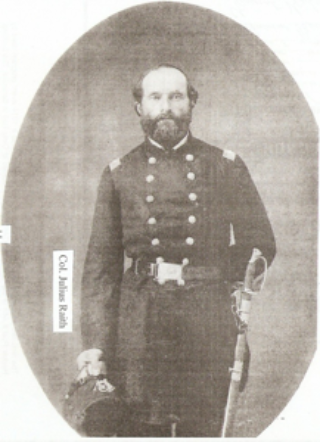
Colonel Julius Raith
Colonel Raith would be mortally wounded by a minie ball, which shattered his leg, at Purdy Road. He would be evacuated off the battlefield by four men, in the process of being evacuated, however the pain was excruciating and he requested that he be sat down so they could go back and fight, so he was placed in a ravine, near a stream. Col. Raith rested next to a tree for over 24 hours, as he was covered by falling branches, bark and splinters, then he was drenched by rain. He was captured by Confederate forces that carried him into a tent, which was retaken by Federal forces shortly afterwards. During his time in Confederate hands, he was treated well. The next day (April 8th) he was evacuated to the steamer Hannibal where his leg was amputated on April 9th. Exhaustion and lack of blood was too great, and he passed away on the night of 11 April 1862 (while being transported to the General Hospital in Mound City, Illinois), after everything was done to save him. It is possible that Colonel Raith was transported to Mound City aboard the City of Memphis, the Federal hospital steamer off Pittsburg Landing, as she did sail for Mound City afterwards, with 700 injured soldiers and suffered 40 deaths on her voyage. His untimely death, left his two young boys (ages 9 & 7) orphans, as they lost their mother in 1859. Colonel Raiths’ remains were returned to Belleville, where they laid in state at the courthouse, for a period of twenty-four hours under the watchful eye of Home Guard troops, until his funeral on April 19th. Originally laid to rest in the family plot in Rentchler, on Turkey Hill, but was removed (after 1900) to the Shiloh Valley Cemetery, along with other members of his family.
The 43rd Illinois was back in action after Shiloh, when they advanced and laid siege against Corinth, Mississippi, on June 6th. Afterwards, the regiment was ordered to the rear, and proceeded to Bolivar, Tennessee where they constructed an extensive system of fortifications around the city. They would be in general vicinity of the Battle of Iuka, Mississippi; but weren’t engaged, on 20 September 1862; and subsequently returned to Bolivar, Tennessee.
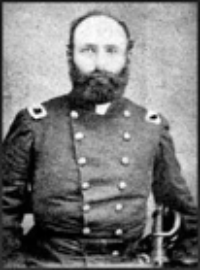
Colonel Adolph Engelmann
On December 18th, Colonel Engelmann was ordered to take the 43rd and 61st Illinois to Jackson, Tennessee; to assist the 11th Illinois Cavalry and the 5th Ohio Cavalry, in drawing out CSA Brigadier General Nathan Bedford Forrest. The weather was cold but forbid the burning of campfires, and Col. Engelmann personally extinguished one set by the 61st Illinois. The morning of December 19th, the Federal plan was enacted, as Confederate Cavalry that took the bait were slow at first, but gathered steam as the Federal Cavalry was in full retreat towards hiding Infantry, under artillery fire. Holding their fire until the Confederates were nearly on top of them, firing by file they decimated their ranks, as Rebels were successfully repulsed, despite their near accurate artillery fire. Forrest was wise to the ruse and sent other cavalry units around Engelmann’s men, and completed their mission, as Col. Engelmann pulled his unit back, out of range of the artillery, which fired on their position for nearly two hours. The 43rd Illinois only suffered one wounded man from the incoming artillery. Unfortunately history records the Battle of Salem Cemetery (a/k/a: Battle of Jackson), as a Confederate victory, as Forrest was able to complete his mission against the small band of Federal troops, despite being checked by Engelmann.
During the Vicksburg Campaign, the 43rd moved towards Yazoo City, Mississippi, as part of Grant‘s Central Mississippi Campaign; and engaged the Confederates in a minor skirmish that pushed rebel forces well outside of Mechanicsburg, on June 4, 1863. From this point forward, Lieutenant Colonel Dengler was effectively in command of the 43rd as Engelmann would command their brigade.
On June 9th, they were assembled into the XVI Corps, under the command of Major General Cadwallder C. Washburn, in a provisional Division, headed up by Brigadier General Nathan Kimball. They were assigned to Engelmann’s Brigade. The 43rd would serve alongside the 61st & 106th Illinois, and the 12th Michigan. They served as the exterior line protecting General W.T. Sherman’s Corps on the siege line, just below Haines Bluff. Their experience around Vicksburg, in a supporting role was one of noise from the constant artillery fire. The artillery fire was noted to be so intense that the earth would shake. On July 12th, the 43rd was repositioned to the Big Black River, and then again on July 22nd to Snyder’s Bluff.
The 43rd (and the XVI Corps) would be reassigned to Arkansas on 29 July, before going on to participate in the capture of Little Rock, Arkansas. The 43rd would have a supporting role in the Battle of Bayou Fourche (Battle of Little Rock) on 10 September, 1863. The battle would seal the fate of the city, as the 43rd Illinois would be the first infantry regiment to move into residence and would be garrisoned there until March 1864.
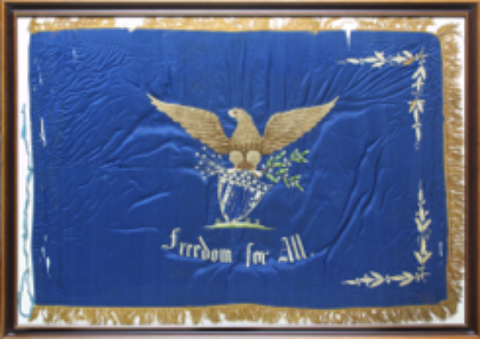
Regimental Flag for the 43rd Illinois
Contained in the collection of the “Old Statehouse Museum” in Little Rock, Ark.
Under the command of Major General Frederick Steele, the 43rd Illinois was assigned to the 1st Division (Brigadier General Friedrich C. Saloman), 3rd Brigade (Col. Adolph Engelmann), alongside the 40th Iowa & 27th Wisconsin. Known as the “Camden Expedition” of the Red River Campaign, they were assigned to be the Northern Pincher to link up with Major General Nathaniel Banks & Rear Admiral David Porter in Shreveport, Louisiana; and push west into Texas.
Steele departed Little Rock, Arkansas with 8,500 men under his command, on 23 March, 1864. As Confederate forces roamed freely throughout Arkansas, the Camden Expedition came under immediate harassment under the direction of Confederate General’s Sterling Price & Kirby Smith. Bank’s orders to Steele were to disregard and push aside Confederate attacks, and advance towards Shreveport.
The men in the 3rd Brigade would engage in a skirmish with Joseph O. Shelby’s Cavalry Brigade; at Okolona, Arkansas; on 2 April, 1864.
On the night of 3-4 April, 1864; the 43rd Illinois (along with the rest of the Expedition) found itself in a terrible position as the Little Missouri River had risen due to the spring rains, they were forced to ford the river, and quickly came under fire by Confederate General John S. Marmaduke’s Cavalry, in what is now known as the Battle of Elkin‘s Ferry. After successfully fending off the Rebel Army, they crossed the river.
The Federal cavalry located a concentrated force of Confederate troops hiding in hazel bushes on the outskirts of a clearing known as Prairie D’Ane, on April 10th. A general advance by the 43rd Illinois & 40th Iowa, pushed the Rebel lines back a mile, where they skirmished until 10 PM, when they repulsed a massive counter-attack. The battle is considered a Union victory, but it was also a Confederate strategic victory as Steele was forced away from his destination of Shreveport. The 43rd Illinois entered the captured city of Camden, Arkansas on 15 April, 1864.
It is fortunate that the men of the 43rd missed out on the twin Federal defeats at the Battle of Poison Spring (April 18) and Mark’s Mills (April 25), where the Confederates showed no mercy to the dead and wounded, while capturing many, to include entire an entire supply train of much needed ammunition & food. The Federal regiments involved were more than routed as the 2nd Brigade, 1st Division (43rd Indiana, 35th Iowa & 77th Ohio) suffered heavily. General Steele was forced to abandon the “Northern Pincher” of the Red River Campaign, and returned to Little Rock on April 26th; with Engelmann’s Brigade holding the rear guard against the advance forces of General Kirby Smith.
The final engagement of the Campaign came between 28-29 April, 1864; at the Battle of Jenkin’s Ferry. In wind driven rain and with the Saline River overflowing it’s banks, a pontoon bridge had to be assembled, and Federal forces entrenched themselves on a ‘beachhead’. The engagement quickly became a desperate, bloody battle. During the battle men of the 43rd, 29th Iowa & 2nd Kansas (Colored) ran out onto the battlefield and captured two of four Confederate artillery pieces then drug them back behind Union lines. Once the Confederates were beaten off, General Steele completed his evacuation, then burned the pontoon bridge. The battle was a tactical Union victory, and was the final fight in Arkansas, that had a tally of over 700 Union killed. The Red River Campaign was ill conceived that cost the Army of Arkansas over 3,000 men out of the 8,500 they started with, with none of the objectives were met, as they returned to their starting point, and the entire Campaign was a Confederate strategic victory. It is uncertain exactly how the soldiers of the 43rd were taken capture, but at least two died in the Confederate Prison, known as Camp Ford, Texas. Another two men of the 43rd were found murdered on a road that linked Little Rock to Arkadelphia, Arkansas, around this time period.
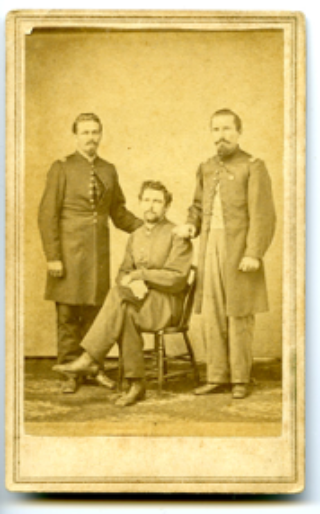
Company E, 43rd Illinois Regiment
L-R: 1st Lt. Emil Koehler, Capt. Joseph Fuess, & 2nd Lt. Bernhard Luckner
On October 1st, Colonel Engelmann received command of the Union Forces in Little Rock, Arkansas. Then on, 16 December 1864, Colonel Engelmann relinquished command of the 43rd Illinois, to Colonel Adolph Dengler, as his original three year term of service had expired. Not quite three quarters of the veterans re-enlisted, so Engelmann petitioned Springfield for D&S (Drafted & Substitution) troops, and the request was granted. The non-returning veterans would also be mustered out and sent home. For the remainder of their time in Little Rock, the Regiment was known as the 43rd Illinois Infantry (Consolidated).
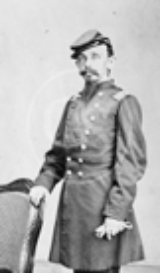
Colonel Adolph Dengler
Beginning in late 1862, recruits were enlisted to backfill the attrition suffered by the Regiment, due to losses sustained in battle and due to disease. Every effort was made to keep the regiment an “all German” unit. By 1864, the recruiters offered one year terms, which many accepted. However, the recruiters had little regard for the “All German” theme, as drafted & substitute soldiers that were assigned to the regiment, consisted of the first warm bodies that they came across. Many of the new soldiers sent as replacements were as young as 16 and as old as 51. As a direct result the “all German” regiment was now being filled by those with English, Swedish, French & Irish decent. Many of the returning veterans found that the unit lacked, under Dengler; but accepted the new soldiers as their own, nonetheless.
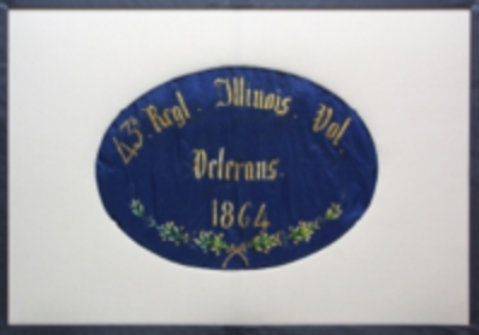
Regimental Flag, 43rd Illinois Infantry (Consolidated)
Maintained in the Collection of the “Old Statehouse Museum” in Little Rock, Ark.
Between 26-31 January 1865, the 43rd did some reconnaissance out of Pine Bluff, Arkansas, towards Camden & Monticello, Arkansas. After the War’s conclusion in Appomattox, Virginia; the War Department ordered the honorable discharge of all the D&S soldiers on 27 May 1865, to be effective on 7 July 1865. A few soldiers whose enlistments were nearly up, were discharged early, as the rest would continue to the end of their enlistments or the stand down of the regiment, whichever came first. From September to November, several soldiers were discharged and sent home. In early November 1865; the 43rd Illinois was mustered out of service on 30 November, 1865. Then they traveled to Camp Butler in Springfield were they where Honorably Discharged from service on 14 December 1865, with their final pay and dispersed towards wherever they called home.
In 1866, by Executive Order of President Andrew Johnson, Col. Adolph Engelmann was one of many to be brevetted to the rank of Brigadier General of the U.S. Volunteers; and backdated to 13 March, 1865. General Engelmann was brevetted “for faithful and meritorious services”. After the war, he (unlike others) never used the title of General, and remained known as a Colonel, perhaps out of modesty. Colonel Engelmann was extremely well liked during his tenure in command, and his soldiers were forever faithful.
By the early 1880’s the men of the 43rd Illinois Infantry Regiment would assemble for reunions, notably at the 1887 G.A.R. National Encampment in St. Louis & the annual Southern Illinois Soldiers & Sailors Association Reunions. The men of the 43rd were extremely active in the Grand Army of the Republic, and made impromptu showings, in mass, when one of their own was sent to the “Bivouac of the Dead”.
After the War, many monuments and placards were erected that mentioned the locations and the feats of the 43rd Illinois.
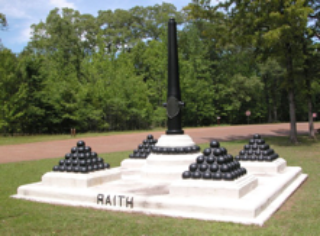
The Raith Monument at the Shiloh National Battlefield
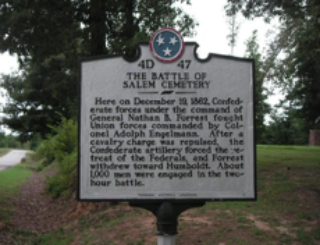
Tennessee Battlefield Marker- Battle of Salem Cemetery
From St. Clair County: 430 Officers & Enlisted Men would enlist into the 43rd Illinois. Of those 430, 62 would give their lives to their adopted country.
271- Belleville 4- Mud Creek Prairie (St. Libory)
56- Mascoutah 4- Lebanon
22- New Athens 4- Cahokia
16- Shiloh 2- Caseyville
12- Illinoistown (East St. Louis) 2- Georgetown
10- Fayetteville 1- Saxtown
7- Freeburg 1- Smith’s Point (Smithton)
7- O’Fallon 1- Centerville
5- Floraville 1- Unspecified St. Clair County
4- Twelve Mile Prairie
23- died from unspecified reasons 11- Wounded in Action – Shiloh, TN (Lived)
15- Killed in Action – Shiloh, TN 11- died of disease
13- deserted 1- died from an accident
11- died from wounds received, Shiloh, TN 1- Killed in Action – Arkansas
Information From:
-Picture of Adolph Dengler
- National Park Service –
http://www.nps.gov/vick/historyculture/43rd-illinois-infantry.htm
http://www.nps.gov/history/nr/travel/national_cemeteries/Tennessee/Shiloh_National_Cemetery.html
- Historical Marker Database – http://www.hmdb.org/marker.asp?marker=38779
- 43rd Illinois Infantry Regiment – http://civilwar.illinoisgenweb.org/reg_html/043_reg.html
- Wikipedia
-Battle of Bayou Fourche-Battle of Poison Spring
-Battle of Iuka-Battle of Prairie D’Ane
-Battle of Jenkin’s Ferry-Battle of Shiloh
-Battle of Corinth-Red River Campaign
-Vicksburg Campaign-Camden Expedition
-Siege of Corinth-Siege of Vicksburg
-Union Order of Battle- Shiloh-Union Order of Battle- Corinth I
-Confederate Order of Battle- Shiloh
-Union Order of Battle- Camden Expedition
- Illinois Muster & Descriptive Rolls – http://www.ilsos.gov/isaveterans/civilmustersrch.jsp
- Internment.net
-Little Rock National Cemetery, Little Rock, Arkansas
http://www.interment.net/data/us/ar/pulaski/littlenat/index.htm
-Keokuk National Cemetery, Keokuk, Iowa http://interment.net/data/us/ia/lee/keokuknat/index.htm
- “Brevet Brigadier Generals in Blue”
By: Roger D. Hunt & Jack P. Brown
Page: 194
© 1990 Olde Soldier Books Inc.
Olde Soldier Books Inc.
– Picture of Adolph Engelmann
- Tennessee Civil War Battle Jackson http://americancivilwar.com/statepic/tn/tn009.html
- Battle Summery: Battle of Jackson, TN http://www.nps.gov/history/hps/abpp/battles/tn009.htm
- Un-cited source found in a binder at the Mascoutah Public Library, from the Internet.
- “A Biographical Sketch of Colonel Julius Raith, 43rd Illinois”
By: David C. Raith
Pages: 10-14
“They Will Not Be Forgotten” – Col. F.K. Hecker Camp Newsletter – July/August 2004
- Mr. David C. Raith
- Mr. Jeffrey M. Dressler
- Memoirs of Gustav Koerner
- “Illinois at Shiloh – Report of the Illinois Shiloh Battlefield Commission”
By: Major George Mason & Stanley Waterloo
© 1905 Illinois Shiloh Battlefield Commission
M.A. Donohue & Co., Chicago, IL
- Recruiting Poster: Early American Auctions
- Old Statehouse Museum http://www.oldstatehouse.com/
- Belleville Weekly Advocate April 18, 1862
- Belleville Weekly Advocate April 25, 1862 – Col. Raith’s Obituary
- Belleville Weekly Advocate October 10, 1890 – Col. Engelmann’s Obituary
- Blue & Grey Magazine “Eyewitness Account” – Col. Engelmann at Salem’s Cemetery Page 4-8
- Find A Grave- Julius Raith (Picture of the Raith Monument)
- Waymarking.com http://www.waymarking.com/waymarks/WM1V9D_The_Battle_Of_Salem_Cemetery
- “Adolph Engelmann: Immigrant Soldier, American Hero” – http://history.siu.edu/undergrad/documents/Legacy_VOL4_2004.pdf
- “Shiloh: The Battle That Changed the Civil War”
By: Larry J. Daniel
© 1997, Larry J. Daniel
Simon & Schuster; New York, NY
Revision: 10
20 May 2013
 heckercamp443