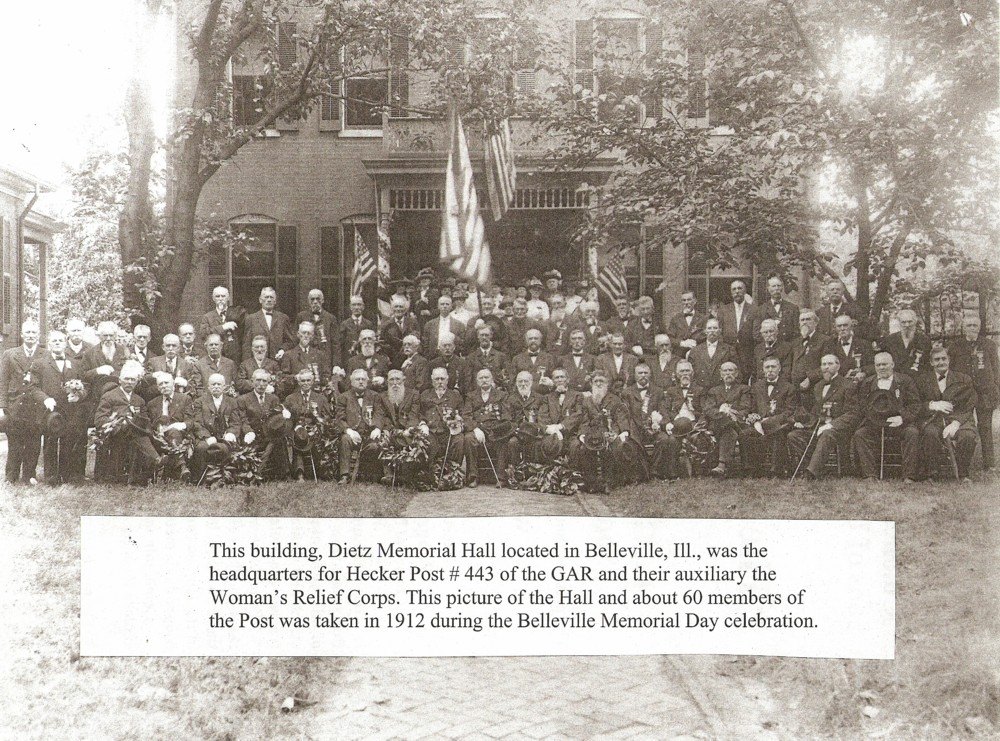
Chapter 1: The Early Years (1884-1889)
Col. Friedrich K. Hecker Camp #443
Sons of Union Veterans of the Civil War
Department of Illinois
Belleville, Illinois
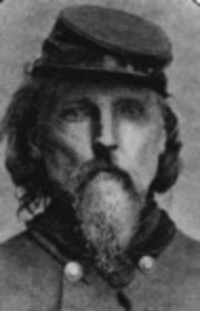
By Jon Stacy, Hecker Camp historian
(Edited and updated by Brother Gerald Sonnenberg, Hecker Camp Secretary and Historian)
Chartered on May 16, 1884, the Hecker Post #443; grew quickly and became a prominent, powerful organization in Belleville. It supported Republican values & in turn was supported by the Belleville Republican machine, namely the Belleville Weekly Advocate (and later the Belleville Daily Advocate), although many claim the Hecker Post was politically neutral. The post was filled with prominent figures in daily life many Professionals (Attorneys, Teachers, Physicians, Dentists & Retail Business Owners) and Tradesmen (Miners, Carpenters, Farmers & General Laborers). Many of the comrades that filled the ranks of the Hecker Post, also were members of the Knights of Pythias, Ancient Order of United Workmen, International Order of Odd Fellows, Templar Knights and Freemasons.
Per a March 16, 1910 article in the new Belleville News Democrat by then G.A.R. Hecker Post Commander Charles Fleischbein, the charter members were: Casimir Andel, George Bender, Charles Becker, John Brunner, Joseph Dietz, Joseph Fuess, James M. Hay, Rudolph Heidinger, James Hughes, August Kurrus, William C. Kueffner, Charles P Knispel, Henry A. Militzer, William H. Powell, Henry Rhein, Conrad Reutermann, Frederick Sunkel, Jacob Spies, Henry Schweickhardt, Charles Siegrist, John W. Smith and William Wolter.
The primary function of the Hecker Post was to carry out two of the Grand Army’s most prominent and sacred rituals, the burial of its comrades and the annual Decoration (later Memorial) Day observances. Another function that wasn’t highly publicized was the with mutual support in dealing with life after four bitter years of “unpleasantness”, in the early 1860’s.
The veterans that made up the ranks of the Hecker Post, came from various states (Illinois, Michigan, Indiana, Wisconsin, Kentucky, New York, Pennsylvania, Ohio, West Virginia and Missouri). Their ranks ranged from Brevet Major General to Private, all were comrades, and treated each other as men. Their ethnic backgrounds were also varied, with the vast majority being German & Swiss immigrants.
The passage of time, and the 1879 Union Veterans Reunion, in Belleville; helped propel the Hecker Post to heights that it’s predecessor the Belleville Post #217, could never attain. With the re-organization of Grand Army of the Republic, the command structure was much simpler, with specific duties assigned to the title the men were duly elected too.
Chapter 1: The Early Years (1884-1889)
On May 6, 1884; the twenty-two Civil War Union veterans came together, for the purpose of forming a new post in Belleville. These veterans were well known and influential within the city limits of Belleville, with names like William Kueffner, William Powell, Joseph Fuess & Casimir Andel. Although there were twenty-two veterans who signed the charter that day, they still weren’t chartered in to the Grand Army. Another meeting was arranged on May 16th, when another thirteen signed the charter. With thirty-five names the veterans were asked to name the Post, and they quickly settled on Hecker, to “honor of that brave and gallant soldier, the late Friedrich Hecker, of this county”. The meeting were organized and chaired by William C. Kueffner.
With the name settled, the veterans elected their 1884 Officers, with Captain Casimir Andel taking command of the Post, and with the Illinois Grand Army Department mustering officer Major Bell, of Springfield, Illinois; present he “duly mustered the boys into service” of the Grand Army of the Republic.
The Hecker Post was quick to get to work, with Decoration Day right around the corner. Without adequate planning, they went out to Walnut Hill Cemetery, where they showed up to honor the memory of Lieutenant Louis Grieser, who served gallantly with the 9th Illinois Infantry. Brevet Brigadier General William C. Kueffner, gave a stirring eulogy, about serving shoulder to shoulder alongside Grieser, recounting their time and the wounds that Grieser received. Members of 9th Illinois Veterans Association were also present in great number, as the funeral was held under the auspices of the Archimedes Masonic Lodge. William Powell represented the Hecker Post when he addressed the Sparta Post 181, during their Decoration Day activities, alongside Reverend Charles T. Philips.
The remainder of 1884 was relatively quiet, as the Hecker Post went on a membership drive to boost their numbers. At one point early in the history of the Post, a comrade (or comrades) approached Colonel Gustav Koerner, about membership within the Post. However, Colonel Koerner declined the offer fearing that the organization would be “abused for party purposes by designing demagogues“.
The Post nominated & elected their 1885 Officers at the scheduled meeting on December 10th; with Post Commander Casimir Andel taking on another year of command. Their were many changes in the post chain of command, with others stepping up.
The 1885 Officers were installed at the regularly scheduled meeting on January 14, 1885; as the Post set off for their first full year of service to the community. They spent the early part of the year in a membership drive, as well as planning their first Decoration/Memorial Day. Memorial Day 1885; Commander Andel issued instructions that each comrade was to wear their membership badge and carry a bouquet of flowers. They were instructed to form up at Post Headquarters at the Abend Building at 2 PM. Unfortunately, inclement weather forced the ceremony inside the pavilion at City Park, which was located at the NW corner of North (A) Street & Richland (2nd) Street. General Powell addressed the gathered, with the music provided by the Bavarian Band. After the weather cleared up, the Post marched to Walnut Hill to strew flowers on the graves of the dead, as Belleville Mayor Weber had the Sexton mark each Civil War grave with small flags. The entire event for the 1885 Memorial Day proved to be a learning experience for all, as the Bavarian Band hadn’t learned all the tunes, but fortunately the drummer kept pace.
With the sudden passing of President (General) Ulysses S. Grant, the Post hastily put together a local remembrance for their fallen leader, at City Park. The stand was reportedly heavily but tastefully draped with emblems of mourning, unfurled flags (to include the battle worn flag of the 12th Missouri, and a picture of the late hero & President “Unconquered Soldier Grant”. With over 1,500 spectators assembled, General Powell delivered a speech that covered Grant’s life.
The remainder of the year, passed quietly as the Post returned to its membership drive. They elected their 1886 Officers on December 9th, with Captain Casimir Andel stepping aside to let his Senior Vice Commander Captain Joseph Fuess, step up and take command of the Post. The 1886 Officers were installed on January 13, 1886; at the regularly scheduled meeting.
With 1886; the Hecker Post was given its first task as instructed by the Department Commander, and that was to gather names of local residents (who served during the War of Rebellion) who were in need institutionalized care, as the Legislature of the State of Illinois, had made provisions for the establishment of a Soldiers & Sailors Home, that was to set up in Quincy, Illinois. Comrade Frederick Sunkel (who worked at the County Clerks office) handled the incoming requests.
For the early part of 1886; many activities were brought up but were all tabled, for one reason or another, however they progressed on Memorial Day. The Post formed up for Memorial Day, and Commander Fuess marched them through the square, where they stopped for a special dedication, at the steps of the court house. A group of unorganized ladies that called themselves the “Daughters of Hecker Post” presented an elegant Post Flag, made of silk. Miss Josie Fuess (the esteemed daughter of Commander Fuess) spoke on behalf of the ladies. Commander Fuess and General Powell spoke in thanks to the ladies, before the Post flag was turned over to the Color Guard, Comrade Martin Heinemann. It flew in a position of honor alongside the war torn battle flags of the 12th Missouri (carried by Comrade Conrad Reutermann) and 43rd Illinois (carried by Comrade Henry Burckhardt). The Comrades of the Hecker Post continued on their way to Walnut Hill, were they formed a square around the grave of Hugo Wangelin, as his grave represented all who were sacrificed in the sacred cause of country. Speeches were given by Comrades William Kueffner & Henry Huhn.
The Hecker Post moved into new quarters effective July 1st, in the Buchanan Building, located at the northwest corner of High Street & 1st (Washington) Street. The rest of the year was quiet, however whether the Post wanted it or not, they reluctantly accepted the formation of an Allied Order in Belleville, as the Mersy Camp #10, Sons of Veterans; was chartered on the 29th of November. This event was most certainly a topic of conversation at their December 22nd meeting when they elected their 1887 Officers. John Heinzelman was elected as Post Commander, after Joseph Fuess stepped aside after one year.
The first of the New Year in 1887; the Hecker Post convened a special meeting, to take action upon the announcement of the news of the passing of General John A. Logan. They adopted seven resolutions, but the sixth one was aimed directly at the Brothers of the Mersey Camp
–6. “We call the attention of the Sons of Veterans to the career of our comrade soldier and able and honored statesman as worthy of their imitation.”
1887 started off rough, but everything takes care of itself. The 1887 Officers were installed on the 26th of January, with a personal invitation from the Mersey Camp to attend their ‘Grand Entertainment’ that was to be held on February 22nd, to honor the birthday of President George Washington, in the pavilion at City Park.
The Hecker Post showed up in great numbers to see exactly what the “Sons” were all about and were pleasantly surprised. The Mersy Camp presented a vocal & instrumental music presentation, with various War tableaux (diorama’s) and scenes of camp life for the admission price of thirty-five cents. The veterans of the Hecker Post were escorted inside the Hall in true military style. The Concordia Orchestra provided the music, as Brother F.A. McConaughy spoke about the aims, objects and purposes of the Camp. He spoke about how in that very spot, many volunteered for the defense of their country, and when it was over many were welcomed home by their friends and family. After the nights entertainment was concluded, a special surprise was in store for the Mersy Camp, as Miss Bertha Becker took the stage with the rest of the Daughters of Hecker Post. After a lengthy speech, Miss Becker presented the brothers of the Mersey Camp a beautiful regulation Sons of Veterans Flag made of dark blue silk, with their Camp name, number and location on it. Needless to say the presentation of the flag was a pleasant surprise to all, to include the Hecker Post veterans.
“I have been assigned the pleasant task of entrusting to you this regulation flag of the Sons of Veterans of the United States of America.
It is the gift of the daughters of the Veterans of Hecker Post, No. 443, Grand Army of the Republic, and is from the hands of sisters to brothers, all children of brave and noble sires.
Our fathers went at the call of their country to battle for right, for home, for us and for the grand cause of human liberty– to battle for all that a freeman holds near and dear. After long years of toll, dangers, and hardships we know not of — they restored peace to a re-united country, and gave to us a heritage the blessing of wise government and the greatest liberty known to any nation on earth. It cost them dear in life and treasure, and we, their children, should hold that heritage priceless. More than two decades have passed since the marshaled ranks have been mustered out and the soldier engaged in the peaceful vocations of the citizen. But the fraternal ties of the veterans are kept alive in the many posts of the Grand Army of the Republic. They meet for wise and beneficent purposes. You, too, have a noble purpose in your organization. You assume the sacred duties of keeping green the memories of your fathers and their sacrifices for the maintenance of the Union; of aiding the members of the Grand Army of the Republic in caring for their helpless and disabled veterans; of extending aid and protection to their widows and orphans; of perpetuating the memory and history of their heroic dead and the proper observance of Memorial Day; of inculcating patriotism and love of country and of spreading and sustaining the doctrine of equal rights, universal liberty and justice to all. These are the grandest of objects and worthy of your greatest endeavors as men and sons of the heroes whose names you bear, and I am sure that you will never be recreant to your blood by proving false to any of these noble duties.
The surviving veterans are yet in the front of life’s great battle. From duty there is no relief, and there is no discharge in that warfare. Their ranks grow thinner before the fire of time, and to these veteran columns no recruits can be enlisted. They alone must represent their organization until the Great Commander musters out the last one. Then these duties, these objects, will devolve entirely upon you. Your ranks may be recruited from generations yet to come, and to the latest day you may perpetuate the memory of the heroic dead, the observance of Memorial Day, still inculcate love of country, and spread wider the doctrine of equal rights and universal liberty to all time shall render aid to the members of the Grand Army and care for their helpless veterans unavailing, when the members are camped in the “silent bivouac of the dead” it will be your solemn duty to keep alive their memories and the principles for which they fought.
Your position is one of glorious responsibility, one of which you may well be proud, for the son of a veteran of the United States of America occupies a prouder position than the son of a ruler of a kingdom. In years to come it will be counted the greatest honor to be able to say: “I am a descendant of a soldier who fought for the maintenance of the American Union and the cause of human rights.”
Unto your hands I commit this flag. Keep it and guard it as your fathers did the flag of the Stars and Stripes. Its color is emblematical of that loyalty and devotion to country which marked their heroism, and which actuate you to follow their example. Take it and with it the warmest assurance of our regard for your organization, and that should it be ever be necessary for you to go, as our fathers did, to the defense of our land, we will encourage you as our mothers did them in 1861, and ever be loyal sisters to the brave Sons of Veterans.” The flag was accepted by Captain Irwin H. Wangelin, Commander, Col. Mersy Camp #10, Sons of Veterans, Belleville, Illinois.
With an Allied Order proving themselves, the Post returned to the business of recruiting. They initiated thirteen at the regularly scheduled meeting on 23 February, with an additional six applications on the books.
The 1887 Memorial Day Ceremony was the first large ceremony held in the City of Belleville, as it was also the first one to hold Divine Services (on the Sunday preceding), and the first one to send decorating committees to other cemeteries other than just Walnut Hill. The Walnut Hill parade, was lead by the Mersy Camp with their drum & fife squad. The “Daughters of Hecker Post” also participated , with 125 Hecker Comrades out of 160. At the ceremony speeches were given by Comrade Robert A. Halbert & Brother W. Sherman Hay, which was followed by taps and a rifle salute. The Belleville Weekly Advocate stated that the “Hecker Post & Mersey Camp which had general charge were faithful to their duties and the efforts made by these organizations have given local importance to the day it never had before”. General W.H. Powell and Reverend C.T. Phillips addressed the Raith Post #587, at the Shiloh Cemetery, in Shiloh.
At the July 27th meeting, their membership drive efforts paid of as the mustered in another fourteen comrades, as their numbers quickly approached 200. During this time the Hecker Post Quartette formed (Robert Besse, John & William Heinzelman, and Otto Ropiequet), and quickly made their mark around town, as they complemented General & Mrs. Kueffner, Judge Pieper as well with General & Mrs. Powell, on the night of August 2nd. The quartette then gave their first performance at the North Branch Farm in O’Fallon, to benefit the Raith Post, on August 30th.
A special meeting was held on September 10th, were they mustered in 11 new members, which pushed their roster over the two hundred mark, which was witnessed by the Wangelin Post #588 Commander Webb. The Quartette sang for the gathered.
With St. Louis hosting the 21st National Encampment of the Grand Army of the Republic, between 27 September- 1 October; the Hecker Post joined their Comrades in the six Posts of the County, and formed the St. Clair County Battalion. The St. Clair County Battalion marched with the Washington County Battalion. During the encampment, Comrades were kept busy with many Regimental reunions, in particularly the 9th, 43rd & 49th Illinois Volunteer Infantry Regiments. During the Encampment, the Grand Parade was held on Tuesday, followed by excursions to Jefferson Barracks & Nashville (Tennessee) National Cemeteries, Pilot Knob, Springfield (MO), Iron Mountain, Wilson‘s Creek Battlefields, a riverboat excursion from Jefferson Barracks to the Missouri River, and an excursion to Lincoln‘s Tomb in Springfield (IL). On the last night of the Encampment a banquet was held for the Officers, Delegates & Representatives to the Encampment by the Citizens of St. Louis, which was followed by a Camp Fire at Schnaider’s Garden & capped off by a display of fireworks. The Mersy Camp (upon invitation of the Shaffer Camp #29, of St. Louis, MO) participated in the Grand Parade with the Concordia Band, and the Mersy Camp made their Headquarters at 201 S. Broadway (the current site of Busch Stadium).
Returning to local activities, the Hecker Post (and assisted by the Mersy Camp) hosted the 9th Illinois Veterans Association on the 25th Anniversary of the Battle of Corinth. During the festivities Generals Kueffner & Powell gave speeches, as the Hecker Quartette rendered old war tunes. The excellent year of 1887 was capped off by an Annual Inspection, that was held on 21 December, and the Hecker Post proved it was a banner Post of the Congressional District. On that evening, the Post re-elected Commander John Heinzelmann to another term as Post Commander following a successful year as commander and as a Post.
On the heels of the most successful year in Hecker history, the Post hit the ground running in 1888; as they attended their delegates attended the “Grand Encampment of the Department of Illinois”, that was held between 12-14 February, 1888; in Springfield, Illinois. The Daughters of the Hecker Post were chartered as the Mersy Ladies Aide Society of the Sons of Veterans, on 13 January, 1888; with Marie Challenor their first President. The Belleville Weekly Advocate blasted the Hecker Post: “The Ladies Aid Society stands in the same relation to the Sons of Veterans, as the Women’s Relief Corps does to the G.A.R. Up to this time there has been no W.R.C. organized in this city as an auxiliary to the G.A.R., but there should be one.”
For Washington’s Birthday, the Hecker Post was in attendance with “almost full force” to see the drama put on by the Mersy Camp & Ladies Aid Society entitled “Enlisted for the War, or on the Home Guard” which featured the Hecker Quartette & Bavarian Orchestra. On stage there was a full length portrait of George Washington, with the stage flanked with the U.S. & Camp flags. After the play, the floor was cleared for dancing that went on well after midnight. The Mersy Camp & Ladies Aide Society gave a special presentation of the drama to the Nashville Post of the Grand Army, on March 6, 1888; to raise money for the recent tornado that struck Mount Vernon, which was another grand success. Afterwards the Mersy Camp was key in the formation of the Meumann Camp #174 that was formed in East St. Louis, as an Auxiliary to the McDowell Post #507, as Brother Arthur Krebs mustered in the Camp on March 16, 1888.
At the regularly scheduled meeting on “Leap Day”, the Post built upon their recruiting successes, by adding an additional three comrades to their ranks, and planned a celebration to mark their fourth anniversary, on 16 May 1888. The celebration was in the form of a “Camp Fire” which had their entire roster of 216 on hand for the public event that was held at City Park. The program included embracing addresses & recitations, musical numbers that featured the Bavarian Band, with vocal solos and the Hecker Quartette. Another attraction was a tableau of the “Battle of Ezra’s Church” that was very detailed, that depicted Belleville native Captain Albert Affleck, who was killed in the battle, that showed his heroic final moments. The dinner was a traditional soldiers meal that included pork & beans, hard tack with black coffee, served on tin plates and cups. The park was illuminated with “soldiers tents”. Dancing capped off the evening under the special charge of the Mersey Camp & Ladies Aid Society. Fortunately, nobody was confined to the Guard House for misbehavior, however the Post Quartermaster reported that over half the spoons were missing.
Immediately following the Camp Fire, the Memorial Day events were next, with the Divine Services conducted by Comrade Reverend Oliver H. Clark, at the First Methodist Evangelical (M.E.) Church. The Parade which featured the Mersy Camp & Ladies Aid Society, the Liederkranz Society & the Bavarian Band. Prior to the start of the Parade, the Roll of Honor was established with it’s initial seven names of fallen comrades. At Walnut Hill, the 94 graves were all decorated, with Brevet Brigadier General August Mersy being the one grave, to represent all graves. Comrades Robert A. Halbert was the guest speaker at the Raith Post’s Memorial Day Observance at Shiloh Cemetery; and William C. Kueffner delivered the afternoon speech for the Raith Post at the O’Fallon Cemetery.
The Mersy Camp & Ladies Aide Society, held a SV Picnic at Glen Addie, which was a sociable affair for the six invited camps, on 4 July, 1888.
As with a fraternal order like the Grand Army, that only allows a select group of the general population in its membership, sooner or later disaster will strike, as it did on August 2nd, 1888; when Comrade Adam H. Russ, died suddenly of sunstroke. His family denied the Post’s request to have him laid to rest with soldier’s honors, but elected to have St. Peter’s Roman Catholic Church conduct the burial. The comrades of the Post agreed to the wishes of the family, and went in force to the Church, but were denied the right to enter the services while wearing their Grand Army badge. After removing their badges, they went and viewed their comrade, they were set back as he was wearing the full Grand Army uniform to include his badge. Notwithstanding, this caused some animosity with the St. Peter’s Roman Catholic Church of Belleville.
The Mersy Ladies Aide Society struck out on their own for a Moonlight Picnic that they organized to be held in the evening of August 21st, with Free Admission and a public invitation. The picnic took place on Elmer’s Hill, with omnibuses leaving the square every half hour for a fare of ten cents. Their first event was a grand success.
With the sudden passing of General Philip H. Sheridan; the Hecker Post (led by General Powell) passed a resolution in his memory, on August 8th. Later that month, the Post received an invitation to hold the reunion of the 9th Illinois Veterans Association, on the 26th Anniversary of the Battle of Corinth on October 3 & 4; the Post held a special meeting on the 29th of August, were it was decided to hold a “Camp Fire” in their honor.
The Post held another special meeting on 17 September, 1888; to decide whether or not to travel to Du Quoin, for the Soldiers Reunion. Forty members and the Bavarian Band, would leave the next day for the reunion, that was held between 18-20 September. The Mersy Camp hosted two distinguished guests. SV (Commander in Chief) General George B. Abbott & Colonel McCrillis, Commander of the Illinois Division. The Mersy Camp Captain Krebs took General Abbot & Colonel McCrillis on a guided carriage tour of Belleville, before meeting with the Mersy Ladies Aid Society. They then were treated to a banqueted lunch at the Liederkranz Hall & they were entertained by the Hecker Post GAR Quartette. Other guests included Captain Drexel of the Gen. John C. Freemont Camp #35 of St. Louis; Captain Charles Lister, Lieutenants F.C. Sterling & B.W. Frau of the Admiral Porter Camp #47, of St. Louis and Captain Edward C. Schuetz of the Meumann Camp, located in East St. Louis. All dignitaries left Belleville, that evening for the Soldiers Reunion in Du Quoin, Illinois, along with the Mersy Camp & Ladies Aide Society.
The 9th Illinois Veterans Association Reunion would be held at the St. Clair County Fairgrounds, with the Camp Fire held at Liederkranz Hall. The Hecker Comrades that weren’t participating in the reunion would march as the Post, in full uniform, in the parade that was assembled with local GAR Posts. At Liederkranz Hall, those in attendance were welcomed by Commander Heinzelman; with General W.H. Powell the Master of Ceremonies. The Hall was beautifully decorated, with the Bavarian Band playing and the Hecker GAR Quartette providing the song. The Hecker Post concluded its busy schedule when it hosted the St. Clair County Soldiers Reunion, at the County Fairgrounds on 10 October, 1888. The Post was given its annual inspection by Captain O.A. Dickerman of Ashley, Illinois, on December 5th. They finished out their second successful year by holding their elections on 26 December, to which they re-elected John Heinzelman as Post Commander for a third year.
The Mersy Camp elected Otto A. Krebs as Camp Commander, and the Ladies Aid Society elected Miss Marie Challenor, President.
The Belleville Weekly Advocate reported that the upcoming Department Encampment, to be held in February 1889; would have over 2,000 delegates & Post Commanders in attendance. The National Commander In Chief William Warner would be in attendance, as Illinois membership has surpassed 30,000 and is increasing.
The year 1888 ended on a sour note, as Captain Robert A. Halbert, noted Belleville attorney, respected Hecker Comrade and the organizer of Company “H”, of the 117th Illinois Infantry; died suddenly on 27 December 1888.
The Post rebounded with the public installation of the 1889 Officers; which was held at the Academy of Music. The Post Officers were installed by GAR Past Commander In Chief Nelson Cole, of St. Louis; on 26 January, 1889.
The Post again turned out in great numbers to catch the latest drama put on by the Mersy Camp & Ladies Aide Society, in honor of Washington’s Birthday, entitled “The Confederate Spy”, which was based on actual events, and they received high praise for the play. The Bavarian Orchestra provide the music for the show and the dancing afterwards.
The Mersy Camp was inspected on 20 May, 1889; and was found to be in “First Class Shape” by Missouri Department Lieutenant Colonel Frauenthal,
Memorial Day 1889; was kept at the same high profile, patriotic event that the Hecker Post was now known for, as the Mersy Camp & Ladies Aid Society, the Bavarian Band & the Kronthal Liedertafel Society all participated. Detail committees were sent out to decorate the graves of 120 Civil War veterans, at Green Mount, & the County Farm; as well as Walnut Hill. The one grave for the year went to their late Comrade Robert Halbert.
Mersy Camp sponsored the “Military Picnic of the Sons of Veterans” at Elmer’s Hill, on the Fourth of July. Many of the St. Louis, Missouri Camps were in attendance, along with the Commander in Chief of the Sons of Veterans General Abbott and his staff. For the 1,000 plus visitors they had, many games were played, to include “Tug of War” and sack races. They also presented for the first time in the city, an exhibition of Japanese day fireworks.
In late July, it was announced that Belleville beat out Effingham and Anna to host the year’s Southern Illinois Soldiers & Sailors Reunion. A committee was quickly set up that consisted of W.H. Powell, W.C. Kueffner and Joseph Fuess; as the City could have an excess of 30,000 visitors, between 25-27 September. The Hecker Committee & City Leaders met with the Reunion committee, at the Thomas House on July 30th. It was announced that 800 tents would be provided by the Reunion committee, as Hecker Post put forth a grand parade, camp fires, musical & literary entertainment, and the city added a grand display of fireworks. The Mersy Camp announced in mid-August that over 100 SV Camps would also be in attendance, and will participate in the Grand Parade. The Belleville Electric Light Company would illuminate the fairgrounds, and Charles P. Knispel would be the Grand Marshall of the Parade. The county fairgrounds would be renamed for the event “Camp Hugo Wangelin”; as a “Sham Battle” would be held, with Mexican & Blackhawk War Veterans in attendance, along with Illinois Governor Fifer. The 9th Illinois, 22nd Illinois, 81st Illinois, 117th Illinois & the 6th Illinois Cavalry would all hold regimental reunions; and 48 GAR Posts would be represented. General William Powell delivered the welcoming speech, as the reunion was a grand success.
In other doing’s amidst the planning of the Southern Illinois Soldiers Reunion, the Post was invited and participated in the Col. Hassendeubel Post #13 (St. Louis, MO) Celebration on August 11th, as they enlisted the services of the Bavarian Band and marched in the parade.
Sad news came from Michigan, that Comrade Adolph G. Fleishbein; was murdered by a highwayman, while returning home with his family, after an extended vacation of fishing, on 27th of August. The Post was quick to condemn this action, and passed a series of resolutions. Then they personally went to East St. Louis, to escort his remains home to Belleville. The perpetrator was eventually caught trying to sell the items he murdered a man over, and sentenced to solitary life in prison, at hard labor.
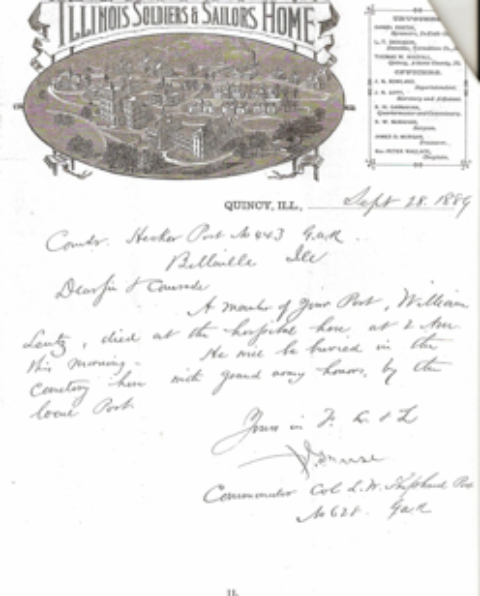
(They Will Not Be Forgotten- Hecker Camp Newsletter, September-October 2010)
The Original in the collection of Mr. R.Mohrman of Smithton, IL
Their December meeting was changed to December 18th, to avoid conflict with the Christmas holiday, were they elected their 1890 Officers. After three years as Post Commander John Heinzelmann stepped aside, and the Post elected Peter M. Romeiser, as their new Commander. Post Comrade Cyrus A. Minor, the Inspector of G.A.R. Posts of the Congressional District, reported that there are 607 members in the county, in eight Posts, had a total of $964.25 in total funds & $539.20 worth of property.
This would be the highest the Hecker Post would attain in their membership numbers (264) and their successes. The election of Peter M. Romeiser would inadvertently have negative effects on the Post, for reasons that are not completely clear.
Information From:
Belleville Weekly Advocate: 23 May, 1884; 27 May, 1898; 6 June, 1884; 5 December, 1884; 9 January, 1885; 5 June, 1885; 14 August, 1885; 4 December, 1885; 11 December, 1885; 8 January, 1886; 29 January, 1886; 4 June, 1886; 2 July, 1886; 3 December, 1886; 17 December, 1886; 24 December, 1886; 31 December, 1886; 7 January, 1887; 21 January, 1887; 25 February, 1887; 20 May, 1887; 27 May, 1887; 3 June, 1887; 29 July, 1887; 5 August, 1887; 2 September, 1887; 16 September, 1887; 23 September, 1887; 7 October, 1887; 2 December, 1887; 13 January, 1888; 27 January, 1888; 17 February, 1888; 24 February, 1888; 2 March, 1888; 9 March, 1888; 23 March, 1888; 27 April, 1888; 11 May, 1888; 18 May, 1888; 25 May, 1888; 1 June, 1888, 10 August, 1888; 17 August, 1888; 31 August, 1888; 14 September, 1888; 21 September, 1888; 5 October, 1888; 7 December, 1888; 21 December, 1888; 28 December, 1888; 3 January, 1889; 25 January, 1889; 22 February, 1889; 24 May, 1889; 31 May, 1889; 5 July, 1889; 26 July, 1889; 2 August, 1889; 16 August, 1889; 23 August, 1889; 30 August, 1889; 20 September, 1889; 27 September, 1889; 4 October, 1889; 6 December, 1889; 13 December, 1889; 20 December 1889; & 12 July 1906
Souvenir & Official Program of the 21st National Encampment Grand Army of the Republic, St. Louis, Missouri
“Memoirs of Gustav Koerner”
 heckercamp443