Casimir Andel
Belleville’s Born Leader
By: Jon Stacy, Historian, Col. F.K. Hecker Camp #443 (SUVCW)
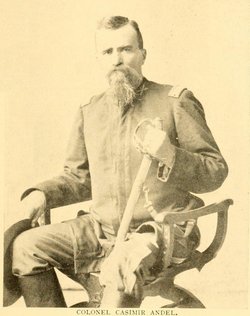
Casimir Andel was born on 15 November 1840; in Woellstein, Germany; the son of Johann & Katherine Andel. He was educated in Darmstadt before he immigrated to the United States in 1860. Initially settling in New Orleans, before heading north to St. Louis and calling Belleville home, along with his brothers Carl and Christian & his sister Elisabeth “Sophie”.
In Lincoln’s initial call for troops at the onset of the War of Rebellion, Casimir enlisted in Augustus Mersy’s Company on 11 April 1861. After the company was sent to Springfield for their initial training, Private Andel was called upon to stand guard, he was approached by a civilian on a military equipped horse. The civilian was instructed to give the password for entrance, but he ignored the command, until Private Andel fixed his bayonet to his musket and applied it to the horse’s neck. Upon learning of the incident, Captain Mersy; immediately promoted Andel to Corporal within the ranks; and was mustered into service as such on 25 April 1861; when Mersy’s Company became Company A, of the 9th Illinois Volunteer Infantry (3 months service).
Having no uniform issued, except for the uniforms given to him by the citizens of St. Clair County prior to leaving Belleville, he had no provisions while assigned to camp in Cairo. With fighting in Missouri and their political, & unlikable commander, Colonel E.A. Paine; Corporal Andel chose not to re-enlist in the 9th Illinois and chose to enlist in another regiment. He was mustered out on 28 July 1861.
Upon his return to Belleville; he was recruited by Hugo A. Wangelin into his company of men that he was raising on 8 August 1861, which was absorbed into the 12th Missouri Infantry, that was being put together by Major P. Joseph Osterhaus. When the 12th Missouri was mustered into service on 10 September 1861; Andel was made a Sergeant in Company B.
He participated in Fremont’s advance into Central Missouri and Curtis’ Missouri Campaign. Andel was slightly wounded at the Battle of Pea Ridge, and was promoted to First Sergeant shortly afterwards. In fact Sergeant Andel’s service at this battle was so noteworthy, he was recognized by name in Gustave Koerner’s memoirs. Sergeant Andel, pressed forward with the Twelfth Missouri through Arkansas and back into Missouri; as they fought in no major battles. In September; with three open First Lieutenant positions open, and over 80 candidates to fill them, Sergeant Andel was selected for one of the positions and was promoted on 21 September 1862, which he then transferred to Company A, during their brief stay in Pilot Knob, Missouri.
The Twelfth Missouri was sent to Helena, Arkansas; to join the Yazoo Expedition under General W.T. Sherman; and was assigned to a Navy gunboat for a brief period; and Lieutenant Andel proved to be such a capable leader, he was made Officer of the Deck, during a watch. Lieutenant Andel led his troops at the Battle of Chickasaw Bayou (26-28 December 1862), the Battle of Chickasaw Bluff (29 December 1862) and the Battle of Arkansas Post (10-11 January 1863). After wintering over in Northern Louisiana; the Twelfth Missouri joined the Vicksburg Campaign; and seen action at the Battle of Snyder’s Bluff (29 April-2 May 1863), and the Battle of Jackson (14 May 1863); before they were sent to attack Vicksburg itself. Lieutenant Andel led a charge against the city, but was repulsed on 19 May; and another on 22 May. The second charge was disastrous for the regiment; as Andel was shot through the right upper arm, while leading his men against a rebel battery. With Captain Albert Affleck wounded in the attack, Andel was left in charge of the company. The attack failed its overall objectives, but laying flat on their bellies, they managed to keep the rebel battery in check from firing against retreating columns of Federal troops. Andel kept his men where they were until the cover of darkness, when they retreated with their dead and wounded.
Following the charge, Lieutenant Andel underwent a surgical procedure on his wounded arm, that required him to return home for recovery; during that time he was Commissioned a First Lieutenant on 7 July 1863, and re-assigned to Company C; however upon his return he was assigned at Aide-de-Camp to General P.J. Osterhaus, in August of that year. Lieutenant Andel was recognized for his services as Aide-de-Camp during the Chattanooga Campaign by General Osterhaus in his official report. Promoted to Captain on 16 May 1864; he was given command of Company D, but never actually commanded the Company. Captain Andel mustered out on 3 August 1864; where he returned to Belleville; and took a position as a cashier, at the First National Bank of Belleville.
In 1871; Casimir was united in marriage to Miss Louise Kircher. The marriage issued five children: George K. Andel, William C. Andel, Coleman E. Andel, Mrs. Josepha (Josephine) Osterhaus, and Mrs. Gisela Burgdorff.
Being very active in the local Belleville scene he was one of many who were involved in the incorporation of the People’s Gas Light & Coke Company; he was a trustee of the Liederkrantz Society, and was the treasurer and director of the Belleville Piscatorial Association.
The respect he earned during the War of Rebellion carried much weight, when Sheriff James W. Hughes needed to form a militia during a Coal Mine strike in November 1874; the Governor approved the request and sent arms to Belleville. The Guards marched through the city, after the Sheriff’s Department posted flyers stating similar to: Any violence will be met in kind. After the strike had subsided, Captain Andel was nominated and elected to command of the “Belleville Guards”, despite not being a candidate or at the meeting. In 1876, the “Belleville Guards” were put under the control of the Governor, as a State Militia.
Captain Andel was forced to put his men of the Belleville Guards (known as Company A, during this time), under arms during the Railroad Strike of 1877; as several railroad workers stole a locomotive of the Cairo Short Line on the morning of 28 July, in East St. Louis and had their sights set on the armory maintained by the “Belleville Guards”. The Sheriff’s Department was alerted in time, quick action on the part of the Guards and the Sheriff‘s Department; the train was derailed, fourteen strikers were then rounded up and arrested by Guards. The Guards were assisted by many trustworthy volunteers, who were mustered into emergency service as members, in the newly composed Companies B through E, along with a mounted detachment, the men chose and elected their own officers and NCO’s. Under the overall command of General William Kueffner (who was on the Committee of Safety), the Guards under the authority of Governor Shelby Moore Cullom, entered the City of East St. Louis after disgruntled workers took control of the rail yards stopping all freight and passenger service into St. Louis. As a result of their arrival, many of the striking workers, went home without further confrontation and the trains began moving again. Following the dissolution of the strike, the Belleville Guards (Company A) under Captain Andel was invited to march in a parade in St. Louis; which they did, with a resounding positive response. The emergency companies of men were dissolved, with their mission completed, and with thanks from the populous of St. Clair County. In November 1877; the railroad gave the Belleville Guards a free ride to and from Mount Vernon, for a parade & review.
Shortly after the Railroad Strike, the “Belleville Guards”, were organized into the 11th Regiment Illinois Militia; again Captain Andel was nominated and elected to the position of Colonel, on 17 September 1877; even know he wasn’t at the meeting or an applicant, but would serve in position, until he stepped down in & was replaced with the election of Major Caleb H. Camfield, in August 1879. The “Belleville Guards” would go on to earn many awards for their precision drills, march in parades and would perform sad tasks. In March 1881; they (led by Major Camfield) performed a burial detail for the famed German politician and leader of the German-American community in the greater St. Louis area, Frederich K. Hecker; when he was laid to rest in Summerfield, Illinois. By 1883; the “Belleville Guards” had all but disbanded.
In 1884; when the veterans of the Civil War decided to resurrect their Grand Army of the Republic Post came together in May of that year, and elected Casimir Andel as their first Commander of Post 443. (Should be noted that Casimir wasn’t on either known roster of the original Post, Post 217, that was active between 1866 & 1872). As Post Commander, Casimir’s term was filled with many firsts, and was busy with recruiting comrades into the order, as he served from 1884-85. After his term as Commander he was only elected as an Alternative Delegate to the 1886 Department Encampment and went to New Athens, Illinois; to initiate twenty new comrades and charter the Grimms Post #641, in September 1887. He remained a loyal member of the Hecker Post #443, for the rest of his life, but left the administration and duties to others.
In April 1886; with a railroad strike in full swing across the country, five people were shot and killed in East St. Louis, with many more wounded. The militia was called out to restore order, and Sheriff Ropeiquet sent additional deputies to the city. On 12 April, the strike came to Belleville on the Cairo Short Line. Mayor Reis wouldn’t stand for such disorderly conduct, and asked Andel & C.P. Knispel to command a posse, to protect the city. The posse was armed with enfield rifles with ten rounds each. There was no further trouble during the strike within the city limits.
When a new National Guard unit was needed in St. Clair County; Company D, 4th Illinois National Guard was formed, and although again, he was not a candidate or at the meeting, he was elected Captain; to which he served. Company D was formed in March 1894, in response to the Panic of 1893, and the growing fears of another nationwide strike, which collimated in the Pullman Strike of May 1894. Captain Andel went to work and drilled his men into a sharp outfit. They participated in many Hecker Post Memorial Day Parades and Ceremonies at Walnut Hill Cemetery; on their first in 1894; Captain Andel marched them to the grave of General W.C. Kueffner; where the fired a salute in his honor. Andel resigned as Captain, of Company D, in late March 1895. They were scheduled to march in the Memorial Day Parade in Belleville, but were forced to miss the 1896 parade as duty called in East St. Louis; after a tornado ripped through the city, causing mass destruction and fires.
At the outbreak of the Spanish-American War; Company D was activated by the State of Illinois for service in the conflict. Governor John R. Tanner; asked Captain Andel to lead the 4th Illinois Infantry; as others candidates for the Colonelcy were untrustworthy, and sent Colonel Hugh Boyle, who was the Assistant Adjutant General of Illinois, to persuade Andel to take the position, which he did only after his fellow officers and men approved, on 19 May 1898. At mustering there was 50 Officers & 994 enlisted men on the rolls, in twelve Companies (A-M). Colonel Andel, led the regiment by example, and generally cared for the welfare of the men under his command. He ensured that individual donations by those at home, went to the Company’s they supported (for example: the Hecker WRC Post #207; raised money and purchased items strictly for the boys of Company D). It is also to be noted: that two of Casimir’s sons (George & William), were both enlisted into Company D.
The 4th Illinois was sent to Camp Cuba Libre, in Jacksonville, Florida; and was brigaded with the 50th Iowa and 1st Wisconsin; under the Command of Colonel D.V. Jackson; in the 2nd Brigade, 2nd Division of the VII Corps. Here Colonel Andel instructed a canteen be constructed to provide a single location for everything his soldiers needed or wanted, namely beer; and he also ordered a bakers oven be built to provide his regiment with fresh bread. It was reported that Colonel Andel was an extremely popular officer amongst his peers, in Jacksonville; as the “Rough Riders” were camped nearby.
By August 1898; the 4th Illinois was transferred to the 3rd Division, 2nd Brigade under the command of Brigadier General James H. Barkley; an much to the soldiers dismay, Colonel Andel put his men to work, to protect them from the idleness of camp life, by clearing a palm grove for a parade ground. During this time, with peace becoming a possible reality and they wouldn’t see the enemy in combat; many soldier disliked the idea of being sent to Cuba as policemen; and by September it looked more like they would be employed as part of the “Army of Occupation”. Colonel Andel was content to do what he was ordered to do by the President of the United States and his superiors in the U.S. Army; when asked what his soldiers wished to do, he freely admitted that he hadn’t polled them to find out, but estimated that it would be close to 75% of them would wish to go home, if peace was declared. Several of the Colonel’s junior officers namely Lt. Colonel McWilliams, Majors Lang, Bennett and Elliott; went over Colonel Andel’s head and telegraphed Governor Tanner, stating that 90% of the men wished to go to Cuba. Many of the regiment’s soldiers accused the four officers with wanting to continue to draw their “exorbitant salaries and that their wishes maybe fulfilled, they resort to coercion, where honeyed speech does not avail…” Once Colonel Andel learned of the betrayal from his junior officers, he telegraphed Governor Tanner himself and placed the four officers under arrest on the charge of flagrant misconduct; and 90% of the soldiers supported their Commanding Officer. Once word reached Belleville of his actions, the Colonel was flooded with letters of support, for respecting the rights and wishes of his men.
The removal of the “jealous officers”, didn’t cease the problems that Colonel Andel was forced to face, as Lt. Colonel McWilliams leveled numerous charges against the Colonel, in fact Casimir was surprised when the arresting officer Captain Parker was sent and read off the charges against him, which included: Mutiny, incompetent & knows nothing of military rules and customs, and using a government horse for his personal use. Colonel Andel, unbuckled his sword and handed it over to Captain Parker, and said he was ready to face his accusers at any time.
Andel wrote a letter to the Jacksonville (Florida) newspaper, stating publicly his position which he stated that he had no personal preface on whether he wished to go home or to Cuba, but would go where his orders sent him. He also stated “When I took command of the regiment, I said that I did so by request of the Governor and by consent of the officers; that my lot was cast with the Fourth Regiment for good or bad; that I would stay with the Regiment, victory or reverse, and I intend to keep my promise. I have no fears as to the outcome when the facts are presented to the court martial that has been appointed.”
For the trial, prominent Belleville attorney (and former member of the Belleville Guards) Gustave Adolph Koerner, the son of the influential Belleville politician traveled with Mrs. Andel and his youngest daughter Josepha. Koerner tried the case before the military court, and had all but one charge dropped, the one that stuck was the charge with the horse. The Colonel’s enemies won a small victory, as he was suspended from rank for six months; the outcome of the trial was immediately condemned by the citizens of Belleville; but the Colonel was confident that he’d win in the end, as he immediately filed an appeal to higher authorities.
It was never directly stated in the newspapers, but it can be surmised that one of his close friends in the Hecker Post, who knew President McKinley personally got involved. Major General William H. Powell; was the President’s commanding officer in the final days of the Civil War, and the two had a lifelong friendship. With that stated, the President interceded almost immediately in the matter in Jacksonville, Florida; who after looking over the case against Colonel Andel, the President overturned the finding by stating: “We will settle this matter on broad grounds, Col. Andel got no benefit from the horse, but the whole regiment did. Technically, there was a violation of regulations, but, considering the peculiar circumstances, the Colonel ought not to be made to suffer. I will set aside the sentence and restore him to his rank.”
Immediately following the resolution to the ordeal, the 4th Illinois was sent to Savannah, Georgia; and was brigaded with the (new) 9th Illinois, and 2nd South Carolina, as part of the First Brigade, First Division of the VII Corps. Colonel Andel, resigned his position on 15 November 1898; and returned home; he was replaced by Lt. Colonel Edwin Swift.
In early April 1899, Casimir learned that his oldest daughter Mrs. Alexander Bergdorf (of Carlinville), gave birth to a bouncing baby boy, giving him the honored title of “Grandpa” for the first time. When the 4th Illinois was mustered out of service in Augusta, Georgia; on 2 May 1899; Company D remained as a cohesive unit, until they returned home to Belleville for a hero’s welcome; before finally disbanding, these men were greeted by their former Commander, upon their arrival. These men would eventually form the John D. Miley Post #20 in 1901 and the John D. Miley Post #75 (Spanish-American War Veterans), in the 1914, both in Belleville.
Casimir Andel, would never again command troops; as he was content being a banker, hosting reunions of the 12th Missouri and his activities with the Hecker Post #443. He took the lead one last time, when he close friend General P.J. Osterhaus, returned to the United States after a life of service to this country in his home of Germany; in 1904. Andel led the Hecker delegation to St. Louis; to greet the retired General upon his arrival, as well as hosted him at his house during his two short stays in Belleville. In September 1907, one of Joseph Osterhaus’ sons Ludwig (Louis); married Josephine Andel, in Belleville.
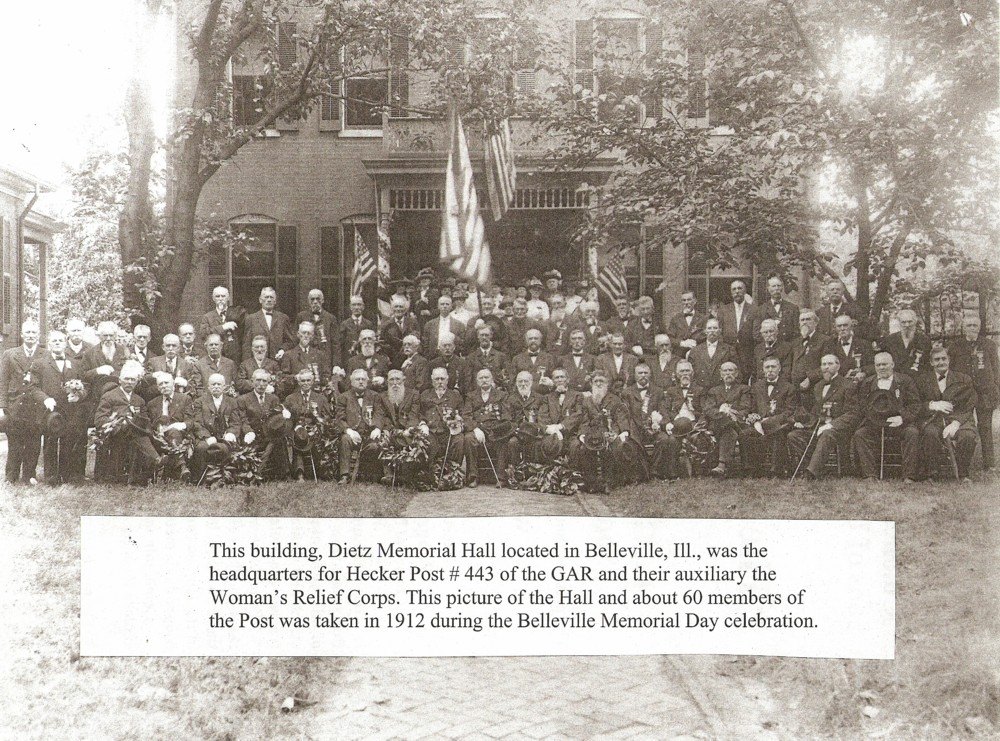
Casimir would serve as pallbearer for his friends and Hecker Comrades, to include: Major Charles Stephani, Charles W. Hilgard, Charles Becker, Henry A. Kirchner, Joseph Fuess, & John Heinzelmann. He served as Grand Marshall for the President McKinley Memorial Parade and Service (1901), and the parade for Southern Illinois Soldiers And Sailors Reunion held in Belleville in 1892. For the vast majority of the Hecker Post’s activities Colonel Andel was seen in the back ground, in fact, in the 1912 Post Memorial Day group photo, he can be seen unassuming and nameless (center row, 4th from the right); his black hair and beard; had turned silver with age. In 1891-92; Casimir was listed as member of the Belleville Board of Education.
After the passing of his close friend Joseph Fuess; Casimir received one last appointment; as he was given the position of President, of the First National Bank of Belleville, on 13 July 1909. Casimir served in that capacity until he retired in 1916, due to ill health and was succeeded by Mr. George B. M. Rogers. Mr. Andel connected with a great many person and his advice on financial affairs was sought by thousands.
Casimir Andel, passed away on 3 February 1918; at his home (315 East D Street) at 2 AM; after suffering a stroke a few weeks before, which inflicted him with paralysis; his remains were transported to St. Louis to be cremated and then laid to rest with military honors, administered by the Hecker Post #443 of the Grand Army of the Republic assisted by the Liederkranz Society; in Walnut Hill Cemetery; he was 77 years old. As his remains were being cremated Miss Aurelia Ludwig sang a favorite song of the Colonel; “Sing Me to Sleep”. His pallbearers were: Theodore Kircher, Carl Andel, Edward Barnickol, William A. Thompson, Ferd Schrader and T.E. Price Jr. His honorary pallbearers were: Victor Gauss, George Gauss, Cyrus Thompson, Edward Abend, H.E. Schrader, William Eeickert Sr., Wiliam Gischer, Philip Gass, Henry Brua and G.A. Becker.
Colonel Andel, earned the military honors and rank he received, he earned the respect of his fellow soldier, comrades and citizens; he did what he was asked & elected to, not matter what the personal costs. He kept his promises, and maintained his lifelong friendships that were made on the battlefield. He earned respect, a born leader of men, and he was a hero for those that knew him.
Information from:
- Belleville Advocate
4 February 1918 13 November 1874 4 December 1874
11 December 1874 18 December 1874 13 May 1898
24 July 1877 23 May 1884 5 December 1884
14 August 1885 5 February 1886 12 March 1886
9 September 1887 30 September 1892 7 October 1892
1 June 1894 24 May 1895 17 May 1895
31 May 1895 29 May 1896 5 June 1896
22 January 1897 28 May 1897 13 May 1898
27 May 1898 17 June 1898 8 July 1898
19 August 1898 26 August 1898 2 September 1898
9 September 1898 16 September 1898 23 September 1898
30 September 1898 7 October 1898 14 October 1898
27 January 1899 14 April 1899 21 April 1899
5 May 1899 17 September 1901 18 September 1901
20 September 1901 23 September 1901 14 March 1902
2 May 1904 6 May 1904 10 May 1904
4 January 1908 1 May 1908 28 June 1909
29 June 1909 30 June 1909 14 July 1909
21 February 1911 6 November 1906 5 February 1918
28 July 1877 3 August 1877 10 August 1877
22 January 1901 7 September 1907 16 April 1886
18 November 1898 9 February 1872 7 February 1873
4 September 1874 23 November 1877 29 March 1895
22 August 1879
Picture (Page 1 of this article) – 13 May 1898
- “Memoirs of Gustave Koerner: 1809-1896; Life Sketches written at the suggestion of his children”
By: Gustave Koerner
pp. 210, 659, Index
Edited By: Thomas J. McCormick
© 1909; Mary K. Engelmann
Torch Press; Cedar Rapids, Iowa
http://archive.org/stream/memgustave02khorrich/memgustave02khorrich_djvu.txt
- Illinois Civil War Muster & Descriptive Rolls – Civil War & Spanish-American War
- U.S. Army Center of Military History, Historical Resources Branch, Spanish-American War: Volunteer Forces
http://www.history.army.mil/documents/spanam/ws-stat.htm
- Wikipedia
4th Illinois Volunteer Infantry
http://www.fortwiki.com/4th_Illinois_Volunteer_Infantry
Great Railroad Strike of 1877 Panic of 1893 Pullman Strike
1877 St. Louis General Strike
- Grave Stone Picture, from the collection of the author, taken Memorial Day Weekend 2013
- John D. Miley Post #75 (Spanish-American War Veterans)
http://freepages.military.rootsweb.ancestry.com/~sunnyann/SSAWV/johndmileycamp-bellville.html
*Information on this site was the product of tiring research conducted by Br. Gene Beals*
- Andel Family Message Board
- 1891-1892 Belleville City Directory
http://www.iltrails.org/stclair/189192b.htm
- Reports of the Battle of Chattanooga, 23-27 November 1863- General P.J. Osterhaus
http://www.aotc.net/chatt-osterhaus.htm
Revision: 6
9 May 2016
Jon Stacy – Historian, Col. F.K. Hecker Camp #443 (SUVCW)
 heckercamp443