By: Jon Stacy, past historian, Col. F.K. Hecker Camp #443 (SUVCW)
Julius Raith was born on March 29, 1819, in Goppingen, Württemberg. At an early age he showed the ability to be a great engineer, and his father gave him a fitting education. In 1837, along with his father, he immigrated to the United States and settled on a farm near Rentchler’s Station, in St. Clair County, Illinois. Here, Julius continued his education by studying to be a millwright in Columbia, Illinois; and quickly becoming an expert.
During the Mexican War, Julius enlisted as a private and was elected the 1st Lieutenant of Company H, 2nd Illinois Infantry. When Captain Don Morrison was promoted to lieutenant colonel of the regiment, Julius was also promoted to captain of the company. He fought in the Battle of Buena Vista, where he won laurels for gallantry after single-handedly capturing the battle flag of the Battalion of Guanajuato, and carried it until he was compelled to abandon the banner.
After the War, he returned to his life’s passion of millwork. In the early 1850’s he married Elizabeth Rebecca Hughes (born February 1832), the daughter of the Honorable S.D. Hughes of Belleville. Afterwards, they moved to St. Louis, Missouri. They had two sons born about 1853 and 1855. Elizabeth died Dec. 29, 1859. In 1860, Julius opened his own business in O’Fallon, Illinois, the Julius Raith & Co., flour mill.
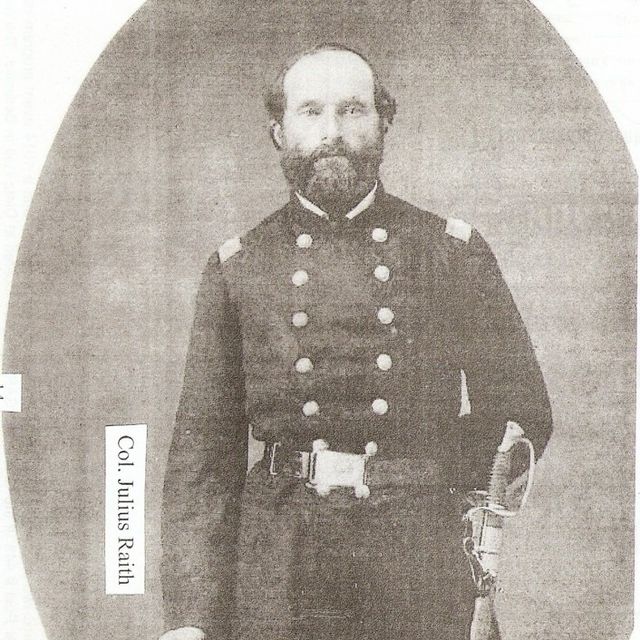
At the start of the Civil War, Julius was persuaded by Gustav Koerner to recruit an All-German regiment. Raith immediately counted on his Mexican War comrade 2nd Lieutenant Adolph Engelmann, and the two began enlisting area German immigrants and first-generation German Americans. Raith and Engelmann got the new Regiment to Springfield, Illinois by Sept. 1, 1861. Being a natural born leader, Julius was appointed colonel of the 43rd Illinois Infantry, by Governor Yates, and mustered in on Dec. 16, 1861. The 43rd Illinois was “promised” to be attached to General Franz Sigel’s Division in Missouri, but to Raith’s dismay, this did not happen. Colonel Raith voiced his dissatisfaction with the converted flintlock muskets they received as they could not fire them. He also made his feelings known to Koerner about being left behind at Fort Henry, during the Battle of Fort Donelson. After being positioned at Pittsburg Landing, Tennessee, Raith did earn the confidence of General W.T. Sherman during a reconnaissance mission on April 4, 1862.
The Battle of Shiloh: On the morning of April 6, 1862, Colonel Raith heard heavy musketry to the southwest of their position and immediately set off to prepare his regiment for battle. He ordered the tents struck and wagons loaded before having the color line formed by 7:30 a.m. During this time, he sent Lt. Colonel Engelmann to inform General John Alexander McClernandthat battle was at hand, only to have Engelmann return to give him word that he was in command of the Brigade. Colonel Raith, without any staff, put together his Brigade (which consisted of the 17th, 29th and 49th Illinois; besides his own 43rd Illinois). However, the 49th Illinois did not heed the warning to get ready, as they rebuffed Lt. Colonel Engelmann. Raith moved his Brigade forward to support Waterhouse’s Battery, when frightened soldiers came running from regiments in Sherman’s and Prentiss’ divisions.
Once the Confederates arrived, they came from the southeast and hit the 49th Illinois position first. As their lines were not yet completely formed, they were overrun. After the regiment broke, they could not be rallied. Riding on horseback, Colonel Raith directed his defenses, which became Sherman’s left flank as they had a strong defensive position to the left of Hildebrand’s Brigade. By 9:30 a.m., Confederate troops were able to flank Raith’s left, which was supported by the 43rd Illinois, and was easily countered for the time being. The Confederates were repulsed in the beginning, but with losses being taken to Hildebrand’s line, Raith found it difficult to maintain his position. At 10 a.m., Colonel Raith ordered his Brigade to fall back and reform at the Purdy Road as they were being flanked.
Around 11:20, with heavy fighting at Purdy Road, Colonel Raith was struck by a minie’ ball in the left leg, which shattered the bone. The pain was obviously unbearable as he fell from his horse. Four soldiers of the 43rd Illinois set upon themselves to save their Colonel and carried him some distance away from the front lines to the rear. In excruciating pain, he instructed them to set him down and return to the battle. They set him near a large tree, next to a stream and returned to the battle. Colonel Raith would remain there for the next 24 hours, having an occasional passing Confederate soldier give him water, and making sure he was ok. One Confederate, however, pilfered his pockets. During the course of the day, he became covered with tree limbs, bark, splinters and leaves that were shot off the tree, and he was soaked from the rain overnight. The following day (April 7, 1862), he was taken to a tent, as a prisoner of war. After the Confederate Army withdrew, he was back in the Union Army.
The next day he was transferred to the steamer Hannibal for medical care, his left leg was amputated on April 9. From here, it is believed that he was then transferred to the steamer City of Memphis, for transport to the General Hospital in Mound City, Illinois. Exhaustion and the lack of blood was too great for him, and he passed away on April 11, 1862.
His remains were returned to Belleville where he lay in state in the County Court House, for 24 hours under the watchful eyes of Home Guard Troops. His casket was adorned with a flag and numerous flowers that were left by the grieving community. He was buried in a family plot on the family farm in Rentchler’s Station, and his funeral was presided over by the Reverend Scarrett with a eulogy by Gustav Koerner. He was survived by his two orphaned sons. Sometime after 1910, his remains and those of his family were relocated from the family farm to the Shiloh Valley Cemetery, in Shiloh, Illinois.
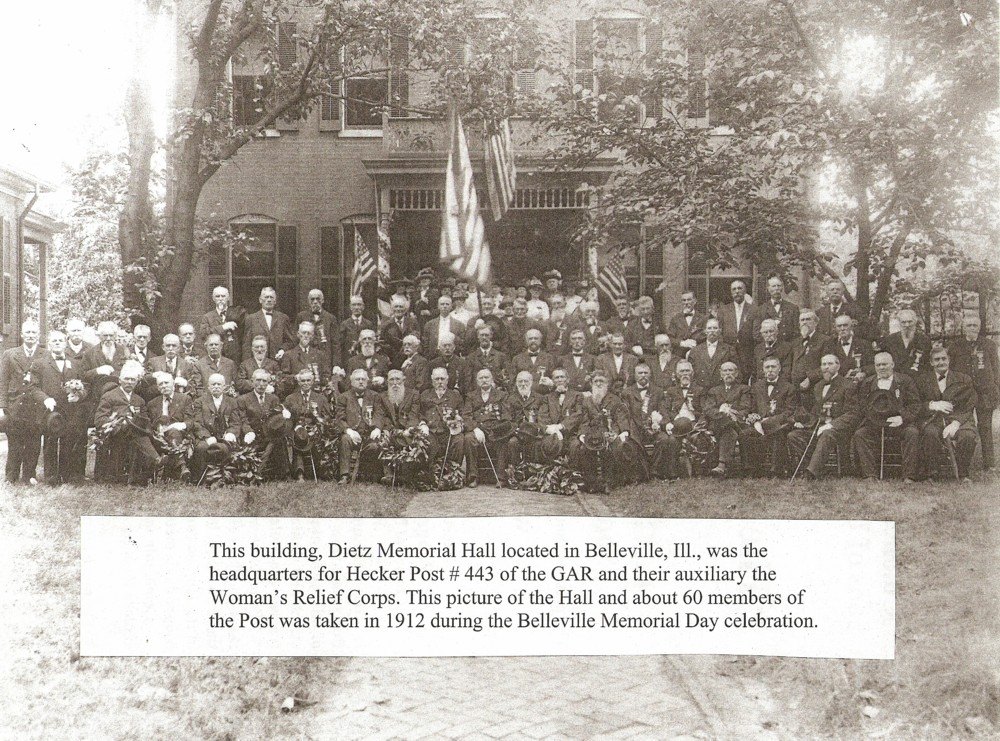
He was honored with the creation of the Raith Post #587 within the Grand Army of the Republic, which was located in O’Fallon, Illinois and existed between 1886-1933.

Tombstone of Col. Raith.
.
 heckercamp443