By: Gerald Sonnenberg, editor
Editor’s note: The following article was originally published in the prior Hecker Camp newsletter called, They Will Not Be Forgotten, in 2015 by P. Michael Jones, executive director of the Gen. John A. Logan Museum in Murphysboro, Illinois, with additional information by Gerald Sonnenberg. Brother Jones passed away in 2023 and was a member of Hecker Camp #443.
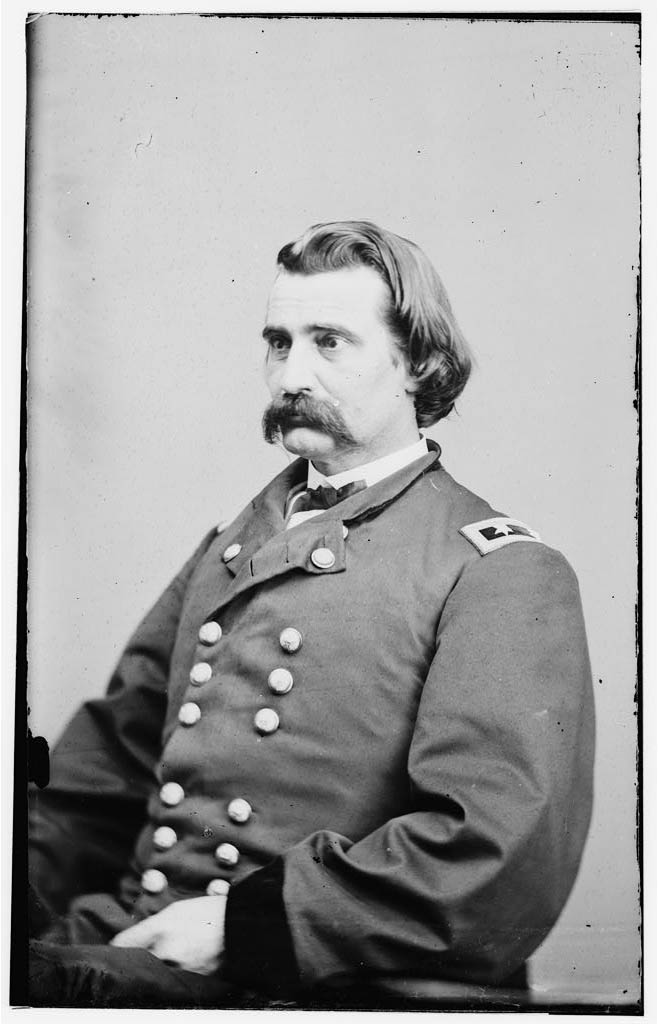
The story of the 31st Illinois Volunteer Infantry began when Illinois Representative John A. Logan climbed onto the back of a wagon in Marion, Illinois’ town square and declared, “the time has come when a man must be for or against his country.” He then invited the men in the audience to join him in the Union Army.
The 31st and its colonel, John A. Logan mustered in at Cairo, Illinois Sept. 18, 1861. It was at this time that Logan, who was a Democrat and was born in the pro-slavery region of Southern Illinois in 1826, assured his men that they were fighting to save the Union. Not a fan of President Abraham Lincoln at the time, he also said that if Lincoln freed the slaves, he would bring them back home. They would not fight an “abolitionist” war.
At the same time, he assured the rebellious states that, if necessary, his men would “hew their way to the Gulf with swords.” Logan would later campaign for Lincoln prior to the 1864 election.
Logan and the 31st fought under Brig. Gen. U.S. Grant’s Expeditionary Command, District of Southeast Missouri at the first of many battles on Nov. 7, 1861, at Belmont, Missouri. Here, the regiment lost 10 killed and 70 wounded. The Battle of Belmont was small and inconclusive strategically, but its casualties taught the 31st the reality of war.
Three months later, the 31st fought at the Battle of Ft. Donelson, Tennessee. Here, the regiment’s stubborn defense of their position cost the lives of 58 men. This was the 31st’ costliest battle, as well as one of its proudest moments. It was at Donelson that the 31st gained its nickname “Dirty-first” for its hard fighting. Logan, wounded so badly that he was first declared dead, was promoted to brigadier general as a result of this battle.
Despite his promotion, Gen. Logan’s connection with his regiment continued, first as a brigade commander, then, after his promotion to major general, as a division commander during the Vicksburg Campaign.
As a colonel, Logan promised to bring his “boys” home if Lincoln freed the slaves. However, by the time Lincoln issued the Emancipation Proclamation in January 1863, Logan accepted the President’s action as necessary. His “boys,” however, had long memories, and desertion became a problem. If they had short memories, Logan’s old friend Col. Ozburn seems to have reminded them of Logan’s promise. Maj. Gen. Logan, then commanding the XVIIth Corps’ Third Division, solved this problem by suggesting that Ozburn’s “poor health” might be a good reason to resign, and the 31st got a new colonel. The unit came to accept emancipation, and after Logan’s further explanation, the recruitment of African American volunteers.
After Vicksburg’s surrender, Logan assumed the command of the XVth Corps in the Army of the Tennessee. This took him away from the 31st.
By the war’s end, the 31st Illinois, which remained in the XVIIth Corps, had marched from Cairo, Illinois, south to Vicksburg, Mississippi, east to the Atlantic Ocean and north to Raleigh, North Carolina; a total of almost 4,000 miles. On this journey, they took part in 14 battles and 25 skirmishes, as well as witnessed the surrender of a large number of Confederate forces. At its end, they celebrated the Union victory in Washington D.C.’s Grand Review on May 23-24, 1865.
On July 13, 1865, the 31st was in Louisville, Kentucky as Maj. Gen. John A. Logan, commander of the Army of the Tennessee, addressed his 30,000 men for the last time. Logan, filled with emotion, told his boys, “Affections have sprung up between us during the long years of doubt, gloom and carnage, which we have passed through together …” This statement must have truly resonated in the hearts of the men of the 31st who had followed Logan to war almost four years earlier.
In the end, 471 members of the 31st volunteers did not return home with 175 dying in combat and 296 dying of disease. The last of these was Pvt. William T. Robinson of Perry County, who died in Louisville on July 2. His muster record records simply that he was “killed,” but it gives no explanation. The 31st officially mustered out on July 19, 1865, In all, 16 southern Illinoisans died in July as the Union army slowly mustered out; 15 by disease and one killed.
 heckercamp443