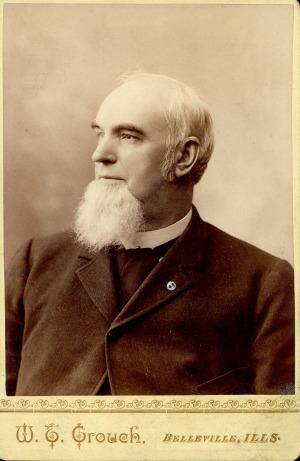
Please meet Major General William H. Powell, who served with the 2nd West Virginia Cavalry. He proved himself to be a credit to the U.S. Army, in a bloodless & brilliant military engagement known as “Sinking Creek Valley”, where he captured the entire 14th Virginia Cavalry (CSA). He would be Prisoner of War, incarcerated in Libby Prison, and was later exchanged for a close family member of General Robert E. Lee, in 1863.
Served as a brigade commander under General Philip Sheridan, in 1864. He would later move to Illinois, and he was a charter member of Hecker Post #443, Grand Army of the Republic. In 1890 he would be awarded the Congressional Medal of Honor, for his actions at Sinking Creek. In 1895-96, he served as the Illinois Department Commander of the G.A.R. Maj. Gen. W.H. Powell, would pass away on 29 Dec. 1904, at the age of 79, in Belleville, Illinois. He was laid to rest a few days later in Graceland Cemetery, in Chicago.
William Henry Powell, was born in Monmonthshire, South Wales, on May 10, 1825, and immigrated to the United States in 1830 with his parents. He lived briefly in New York City, before moving to Nashville, Tennessee in 1833. His family then moved to Wheeling, Virginia in 1843.
At an early age, he had an interest in the iron and nail industries and received an education that was fitting for him. He became a mechanical engineer and involved himself in the iron industry.
On Christmas Eve 1847, he married Sarah Gilchrist in Wheeling, Virginia, and they eventually had six children. Two children died in infancy, and one died at age 20.
By 1852 or 53, he supervised the construction of a nail mill known as Point Mill, in Benwood, Virginia near Wheeling. By 1853, he worked as a manager and, later, general manager of the Lawrence Iron Works in Ironton, Ohio.
During the War
In 1861, he answered the first call for troops by President Lincoln and recruited a company of men that was intended for Ohio service, but was transferred to Virginia under the Loyalist Government set up by F.H. Pierpoint. The regiment became the 2nd Regiment “Loyal” Virginia Cavalry. He was elected captain of Company B.
The 2nd Loyal Virginia Cavalry Volunteers would remain in Western Virginia fighting rebel forces that threatened to force their way into the Pro-Union part of the state. By October 1861, shortly after they were mustered into service in Petersburg, Ohio, the 2nd Loyal Virginia Cavalry served in Northern Kentucky and all over the Appalachian Mountains. By early 1862, Powell received a promotion to the rank of Major.
In October 1862, the 2nd was ordered into winter quarters, but the war continued to rage on. On Nov. 24, the 2nd was ordered to break up an encampment of the 14th “Rebel” Virginia Cavalry, who were in winter quarters and recruiting locals.
A storm system moved in Nov. 25, and they found themselves in a blizzard that deposited heavy amounts of snow in the Appalachian hills, which was followed by bitterly cold temperatures.
The 11th Ohio Infantry, which was to support the 2nd Cavalry, had to retreat due to the heavy, foot-deep snow. The 2nd Cavalry was also forced to hold up in their mission. However, Major Powell led a volunteer group to see if they could complete their mission.
Sinking Creek Raid
On the morning of Nov. 26, standing on a hill top, they observed the encampment of Rebel Cavalry, and Powell had a bold idea. He and twenty of his men, charged down the hill, in heavy snow, and after a brief hand-to-hand fight, he asked the Confederate forces to lay down their weapons and return to their base camp as prisoners. Surprisingly, the Confederate Virginian’s immediately agreed. Most were later paroled and released.
Historians in West Virginia call this the Sinking Creek Raid, it was a bloodless, daring, brilliant and one of the most successful expeditions of the entire war. They captured many weapons, half the regiment’s numbers of men, officers, horses, equipment and a “beautiful silk flag made for, and but recently presented by the lady friends of the regiment in Staunton, Virginia.” Major Powell kept for himself, a war prize, a double-barreled London twist shot-gun, containing 18 large buckshot in each barrel. Powell and his men were on the move for over 74 hours. He would soon see another promotion to lieutenant
colonel for his gallantry.
On May 18, 1863, he became the third colonel to take command of the 2nd Loyal Virginia Cavalry, and he would find great success. Then, on July 4, 1863, when West Virginia became its own state, Ohio transferred the Loyal Virginia Regiments to the new state, and the unit became the 2nd West Virginia Cavalry.
On July 18th, 1863, Col. Powell led the 2nd West Virginia into the town of Wytheville, Virginia, which is nestled in the Blue Ridge Mountains. Powell and the 2nd West Virginia Cavalry were riding under the command of Col. John T. Toland, who had nearly 1,000 soldiers under his command and was given three objectives; one of which was to destroy the railroad line of the Virginia and Tennessee Railroad in Wytheville. The Virginia Home Guard was tipped off that the Union Cavalry was nearby and readied their defense, the day before. When the “Yanks” rode into town, the assault was quickly stamped out by the local militia, comprised of about fifty old men and boys known as the “Wythe Greys.” Here, Col. Toland was shot and killed, while Col. Powell was shot through the shoulder and left on the battlefield for dead.
Captured
He was taken capture by the Confederate Army, treated for his wound and incarcerated in Libby Prison in Richmond, Virginia. The Confederates soon learned that Col. Powell was a
dangerous man after he assaulted a prison guard. Afterwards the Confederates made his stay quite uncomfortable. He was confined to the prison dungeon as punishment for his reprisals upon Confederate forces.
The Confederates offered Powell for Col. Richard Henry Lee as an even trade. Powell was released from Libby Prison in March 1864, having spent a total of seven months in Libby Prison. He returned to Washington D.C. where he met with President Abraham Lincoln, his cabinet and both houses of Congress. Upon his return, he was given a heroes welcome in Ironton, Ohio as the residents presented him with a gold watch, a horse and
equipment, a sword and two revolvers.
He was quick to return to his unit, and led them during Sheridan’s Valley Campaign when they were basically fighting on their home territory. They helped cut the Shenandoah Valley off from Confederate Forces.
During the Battle of Opequon on Sept. 19, 1864, he commanded the 2nd Brigade of the 2nd Division, under the direct command of Brevet Maj. Gen. William W. Averell. Col. Powell led his Brigade and his Regiment in combat during the Battle of Fisher’s Hill Sept. 21-22, and at the Battle of Tom’s Brook on Oct. 9.
He relinquished command of the 2nd West Virginia Cavalry on Oct. 19, 1864 after promotion to brigadier general. He then commanded the 2nd Division of Cavalry Corps under Maj. Gen. Alfred T.A. Torbert. His promotion took place on the same day as the Battle of Cedar Creek.
Afterwards, General Powell was ordered by General Sheridan to, “Drive him, and don’t stop until you have pushed him through Port Royal (Virginia).” Powell followed his orders to the letter, and pushed the Confederate Army out of Northern Virginia. Afterwards, General Sheridan ordered Powell to, “…follow them up and give them hell, damn them.”
General Powell later resigned due to severe illness in his family. After the War, he returned to Ohio and was Brevetted to major general in 1866. During the Civil War, he established many friends throughout the country, including future President William McKinley. During the war, Powell was involved in 61 battles and engagements, and rose from captain to brigadier general.
After the war
Powell returned to business in
Ironton, Ohio, as the manager of the Ironton Rolling Mill Company. By 1868, he was employed as a manager of the Clifton Nail Works, in Clifton, West Virginia.
In 1868, he was the Republican elector from the Third West Virginia district, was offered and declined the nomination to Congress from his home district (in 1866 he refused a similar honor in Ohio).
Powell moved to Belleville, Illinois in 1876 to assume the position of General Manager of the Belleville Nail Company, where he remained employed until 1882. Two years after Powell’s move to Belleville, his wife Sara died. She had been diagnosed with cancer, and died seven months later while only 54 years old.
On April 29, 1879, General Powell married his second wife Mrs. E.P. Weaver. In 1882, he became the President and General Manager of the Western Nail Company in the small community of Pittsburgh, Illinois (located near the current site of the Shrine of Our lady of the Snows, in Belleville). Powell remained in this capacity until the Western Nail Company was reorganized in 1888, leaving him in a diminished position. He sold his shares in the company in 1889.
General Powell is listed on the 1883 St. Clair County Civil War Pension listing as receiving $7.50 for a wound to his shoulder, to which he never fully recovered. W.H. Powell, was extremely well liked and respected in Belleville as he was in many respects a, “Pillar of the Community.”
His Civil War accomplishments were acknowledged on July 22, 1890 when he was recognized by the U.S. Congress with the Medal of Honor, for his actions at Sinking Creek Valley, Virginia, the citation reads:
“Distinguished service in the raid where twenty men and he charged and captured the enemy’s camp, five hundred strong, without loss of man or gun.”
The Medal of Honor was sent to him via registered mail.
Involvement in the SUVCW
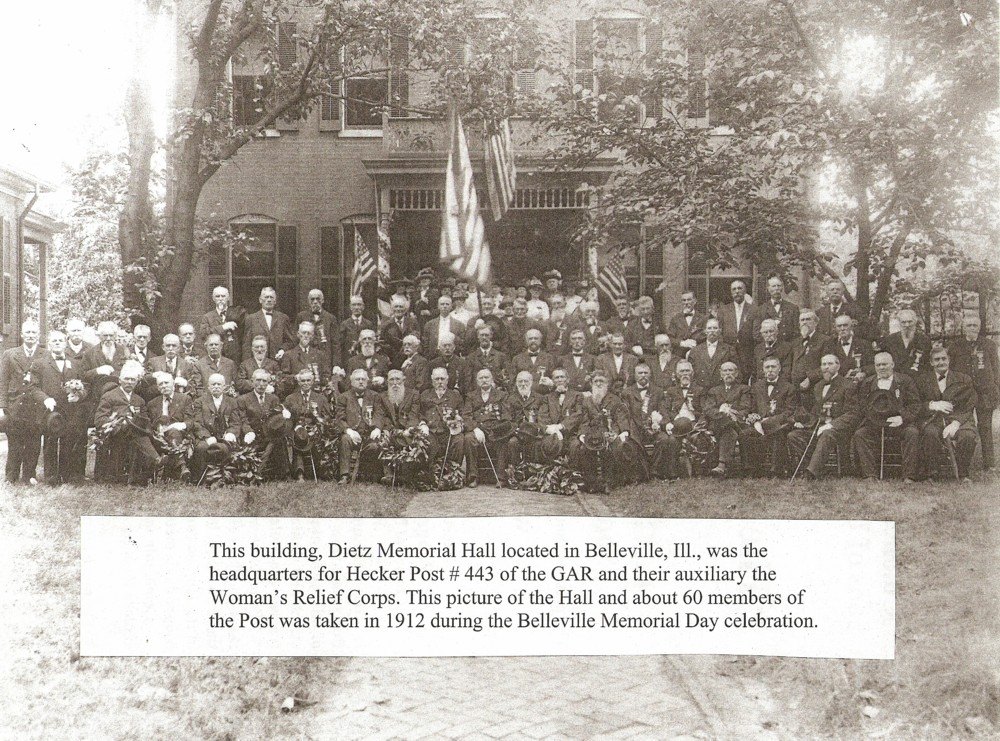
Powell was one of the original 22 signers of the Charter that established the Hecker Post No. 443, Grand Army of the Republic (GAR), on May 6, 1884. He was installed as the Post’s first senior vice commander.
On June 1, 1895, he began serving one year as the Illinois Department Commander of the GAR He quickly made it a point to travel the State and visit all of the GAR posts. He traveled tirelessly to meet as many comrades of the Grand Army as possible, to include those at the Quincy Soldiers & Sailors Home. He worked to improve the Grand Army and their causes, like the Orphan’s Home.
Later life
He had deep respect for those he served under and with, and spoke very highly of General’s Grant and Sheridan after their passing.
In 1897, President McKinley appointed his old friend to Internal Revenue Collector for the district, that included Belleville. His last known public appearance was that of the return of General P. Joseph Osterhaus’ to Belleville, in May 1904.
Brevet Major General William H. Powell passed away at his home at the age of 79 Dec. 26, 1904. His funeral took place at his home Dec. 28. His comrades of the Hecker Post performed funeral services, for his friends and family in Belleville. At his families’ request, his remains were placed on a train bound for Chicago, on Dec. 29, 1904, where he was later interred in Graceland Cemetery, in Chicago, Illinois. He was survived by his second wife and two daughters, one son, four grandchildren, his brother and sister.
He was active not only with the GAR, but also the Society of the Army of West Virginia, and the National Association of Union Ex-Prisoners of War. He was a consistent Christian and a church going man.
 heckercamp443