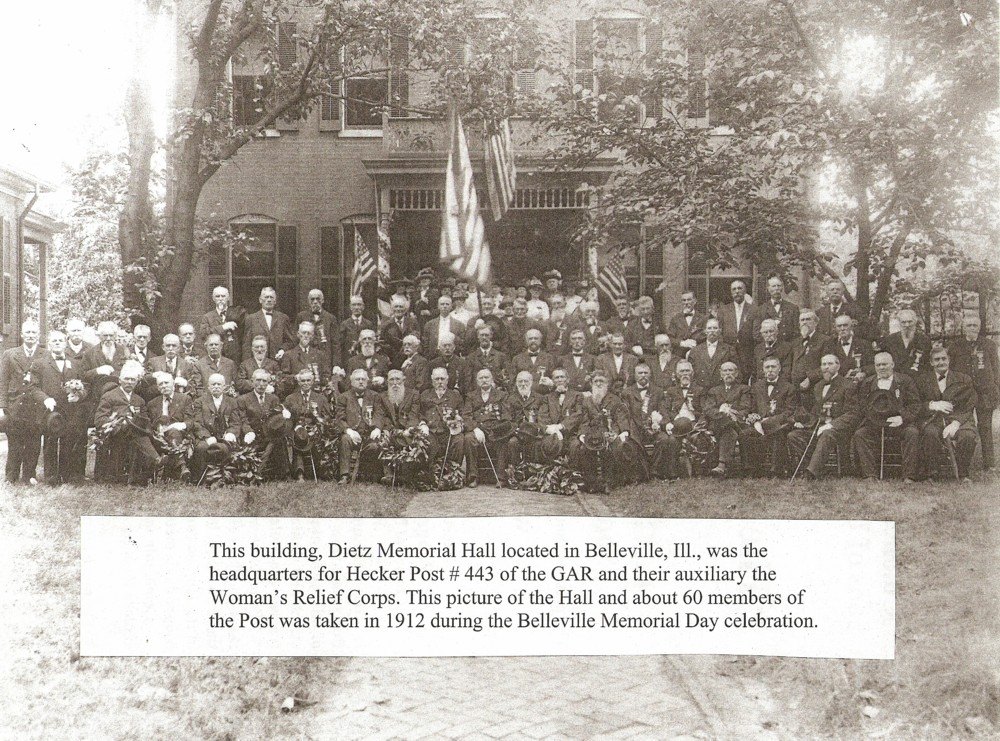
Major General Peter Joseph Osterhaus
“Old Hell Smell”
By: Jon Stacy
Col. F.K. Hecker Camp #443, Historian
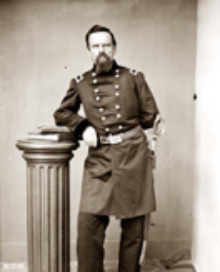
P. Joseph Osterhaus was born on 4 January 1823; in Koblenz, Germany; the second of three sons to Josef Adolf Oisterhusz & Eleanora Kraemer; his parents chose to give their sons a German spelling of the family surname. Joseph grew to a height of 6’2” with red hair and blue eyes. At the age of 17 he entered a three year business apprenticeship, before his mandatory military schooling as he attended the Berlin Military Academy, where he was an apt student. Served one year of drills with the Regiment 29, 3rd Rhine Infantry; followed by another six months in the reserves as a 2nd Lieutenant, in the 29th Reserve Regiment.
He moved to Mannheim in 1845, and married Matilda Born on 26 August 1847. He supported the Revolutionists led by Friedrich K. Hecker, during the uprising of 1848-49. In December 1848; he was elected Major of one of two batteries of the Mannheim Citizens Army. By May 1849, he was the defacto military commander of Mannheim, and was appointed Colonel in June. was tasked with forming fellow rebels into a worthy army in Mannheim to counter the Prussian Army. His time with the Revolutionists, taught him more about the art warfare than the Military Academy. By mid June, with the revolution about to be put down by his fellow Prussian troops, Osterhaus fled to the United States; with his wife and the brother-in-law’s of Frederich K. Hecker. He found himself a fugitive, under the change of treason. In October 1849; the Osterhaus’ and the Hecker in-laws, departed LaHarve, France; onboard the “Argo”, traveling 2nd Class. His brief stint as a military commander was overshadowed by Franz Sigel’s, even know Sigel’s military operation was a complete failure.
Arriving in New York City in November 1849; and would soon settle in Belleville, by the end of the year. Upon his arrival, he was greeted by Gustave Koerner. During his time in Belleville, he established himself as a respectable businessman, and garnered success, by opening a General Store at 150 Main Street (the Belleville Advocate, didn‘t mention east or west). In 1851, his son Hugo was born in Belleville (and would go on to receive wartime accolades, in his own right). In 1852, he sold his store and relocated to Lebanon, where he was the village’s Postmaster from 1853-57. During a formal dinner in 1856, Joseph and Matilda sat next too Abraham Lincoln, who was in town stumping for Republican nominee John C. Fremont. Joseph received word that he received a full pardon for his actions in the failed revolution in Baden, on 8 July 1856. Osterhaus went into business opening a distillery, in addition to Postmaster, but the stock market crash of 1857, he quickly found himself out of work and deeply in debt, he was forced to take a job as a clerk. In late 1960, a job offer came in, which paid significantly more and so he moved his family to St. Louis, and settled on Gratiot Street between Broadway (Fifth) and Sixth in most like a row house (authors note: the area described in 2016, is a power station on the south side or a parking lot on the north side).
Osterhaus would enlist as a private in Brigadier General David M. Frost’s 2nd Missouri Reserve Corps February 1861. Since pro-union volunteer militias were all but outlawed in Missouri, they were forced to train in secret. After Nathaniel Lyon militarized the 2nd Missouri Reserve Corps, as the 2nd Missouri Infantry, Osterhaus was elected Captain (after Otto Schadt, resigned the commission and insisted that Osterhaus be elected, as he served under him in Mannheim) of a company, in April 1861; as part of Lincoln’s initial call for troops; and within two weeks of his enlistment he was appointed Major (7 May 1861) of the regiment. He was present and accounted for during the Camp Jackson Affair (10-11 May 1861); which he marched past Ulysses S. Grant & William T. Sherman; who were civilians at the time.
The 2nd Missouri marched on Jefferson City, Missouri; after negotiations failed between Lyon and Missouri governor Clairbourne F. Jackson. Upon their arrival, not a shot was fired, as the city fell to Union forces peacefully. Osterhaus led the way for Lyon’s rout of the Missouri Volunteer Militia at the (First) Battle of Booneville, which was basically a big skirmish; the Missouri Confederates under Marmaduke, complained that Osterhaus didn‘t fight fair, as he had his infantry lay flat for their protection, while artillery batteries were called up.
General Lyon received word that Sigel was besieged at Cathage, Missouri; forced marched his troops from Boonville, 50 miles in 30 hours; and joined him in Springfield, Missouri. By late July, the 2nd Missouri’s enlistments were up, but they didn’t want to leave, itching for the expected fight coming. Osterhaus was ordered by General Fremont to form a three years service regiment and he immediately sent Otto Schadt to recruit what would become the 12th Missouri, which contained many veterans of the 2nd Missouri, who didn’t return with Schadt to recruit the new regiment.
Osterhaus commanded 3 battalions at the Battle of Wilson’s Creek; and they were all over the battlefield; as Sigel’s troops were routed and failed to shore up Lyon’s lines; once the ammunition ran out, they fell back towards Springfield. Thanks to Osterhaus’ training, his three battalions only suffered a 24% causality rating. The battle at Wilson’s Creek, was Osterhaus’ first ‘official’ battlefield experience.
Upon his return to St. Louis; after receiving new uniforms and much needed supplies in Rolla (17 August 1861); he took command of two companies of Belleville soldiers who volunteered to join the 12th Missouri under his command, after hearing of his success at Wilson’s Creek. He selected many of these Belleville men as officers of the 12th Missouri, since he already knew and trusted them, namely Hugo A. Wangelin.
After a brief but intense drilling and training session, the 12th Missouri departed on 19 September 1861; for Jefferson City; Fremont assigned him to command the 2nd Brigade of Sigel’s 3rd Division, effectively ending his command of the 12th Missouri; and giving command to Wangelin, as Schadt was still in St. Louis recruiting and training, the last companies of the 12th Missouri. Osterhaus’ Brigade consisted of the 12th Missouri, 17th Missouri and the 44th Illinois.
When Fremont was relieved of duty on 2 November 1861; Osterhaus being the professional soldier, wasn’t happy about the decision, but understood military matters; in contrast to Sigels’ offer to resign. Fremont was replaced by Henry Halleck, and Halleck refused Sigel’s resignation, so he took a months leave. Osterhaus in the interim effectively had command of the U.S. Army in Missouri; until relieved by General Samuel R. Curtis; during the time Osterhaus ordered drills, parades and various duties too keep the volunteers busy and in cohesive units. Halleck pushed through Osterhaus’ promotion to Colonel, despite the lack of companies in the 12th Missouri, effective on 19 December 1861. Halleck also promoted Curtis to Brigadier General, which caused Sigel to become irate and openly complained in the newspapers against Halleck. General Curtis, appreciated Osterhaus’ readiness of the troops, and recommended him for another promotion to Brigadier General, but Halleck delayed the request due to Sigel’s public tantrums.
With the beginning of 1862, Osterhaus and the 12th Missouri were re-organized into the Army of the Southwest. Curtis advanced on Springfield (once Sigel had returned) and then pursued Confederate General Sterling Price into Arkansas, by the beginning of March. Within a short amount of time, Osterhaus proved himself a valuable asset to the Union cause.
At the onset of the Battle of Pea Ridge, Osterhaus had command of the First Division (12th Missouri, 17th Missouri, 25th Illinois, 36th Illinois, 44th Illinois, 4th Ohio Artillery & 1st Missouri Battery) under General Fritz Sigel. On the morning of the 7th of March, General Curtis sent Osterhaus north with his Division, a cavalry regiment and twelve cannon; to perform reconnaissance along Ford Road. They stumbled into the main body of Confederate troops under General Benjamin McCulloch. Osterhaus ordered his cavalry force to attack, and his infantry to deploy while sending word to Curtis. Osterhaus’ attack was a tactical failure, as McCulloch literally stampeded them, but the melee that ensued destroyed the morale of the southern troops. McCulloch was killed (by the 36th Illinois), along with one of his lieutenants and another was captured. With the report making it to Curtis in time, he was able to send reinforcements led by Colonel Jefferson C. Davis (Commander of the 36th Indiana Infantry), which arrived in time to shore up the Osterhaus Division, while Osterhaus was lobbing artillery blindly upon the Confederates, and in turn they were able to “box in” the Confederate right flank under Louis Hebert.
The next day Osterhaus was instructed by Sigel to scout the open prairie west of Elkhorn, which he did and suggested artillery and troop positions, which Sigel agreed too. Once everything was placed, the Union attack began with the artillery providing devastating fire with 40 artillery pieces, which nullified their Confederate counterparts, afterwards they fired directly into the woods against troop positions. When Osterhaus was directed to begin his infantry assault, he was lightly resisted by Henry Little’s 1st Missouri Brigade. After the battle, Curtis and Sigel took credit for the victory, but Curtis acknowledged Osterhaus’ performance and Halleck rewarded Osterhaus with a promotion to Brigadier General and he officially handed over command of the 12th Missouri over to Colonel Hugo Wangelin. Once Sigel was transferred to the Army of the Potomac, Osterhaus’ took command of Sigel’s First Division, a position where he would shine.
General Curtis continued to move southwards into the heart of Arkansas, with Osterhaus commanding his division which included the 12th & 17th Missouri Infantries and the 4th Missouri Cavalry. As the Federal force approached Little Rock, Curtis’ supply lines couldn’t keep up with the advancing soldiers, and Osterhaus was ordered on 19 May 1862; by Curtis to send out foraging parties to the nearby farms. The foraging parties mainly companies of the 17th Missouri and supported by the 4th Missouri Cavalry crossed the Little Red River and proceeded towards two farms on Whitney’s Lane, where they were attacked by Texas Cavalry. Companies F & H; of the 17th Missouri were quickly routed by the untrained Texas Cavalry & Arkansas volunteers; in a massive assault upon the unsuspecting Federal troops. Company G, 17th Missouri and the 4th Missouri Cavalry; began the counter-attack; as the Osterhaus Division began to respond to the sounds of firing and began to reinforce their foraging party. Before Osterhaus could take control of the situation, the Confederate troops retreated & ended the Battle of Whitney’s Lane; which was no more than a skirmish. The Federal troops scored a victory on the field, however the Confederates gained a psychological victory as Curtis, began to consider his stretched out supply line; he pulled back from taking Little Rock, and set his sights on Helena, Arkansas. This skirmish left it’s mark as the 17th Missouri lost approximately 1/3rd of their 68 men lost in the war at Whitney’s Lane (a little over 20 men).
General Osterhaus, was inflicted with malaria, but remained with his troops until July 1862; when he was sent home to recover. He returned in August, but the malaria came back this time knocking him out until December. When he returned, General Grant assigned him as the commander of the 2nd Division under General James A. McClernand’s XIII Corps; for the Vicksburg Campaign.
At the Battle of Arkansas Post (10-11 January 1863). Osterhaus’ primary task was to silence the Confederate artillery positions at Fort Hindman, which he successfully accomplished, as the large guns couldn’t depress far enough to return fire. He detached two brigades from his division, along the levee which met dismounted cavalry and overran their lines. On the second day, Osterhaus anchored the Union line at the Mississippi River, while only advancing one brigade. General McClernand was planning a massive assault, when the men became entangled in a small arms fight, just as the Confederate leadership hoisted white flags of surrender. General Osterhaus’ actions were key to the Union success during this battle, however he received no public or official credit.
Under a reorganization, Osterhaus’ Second Division became the Ninth Division under McClernand; while his Division was deployed aboard Admiral Porter’s Fleet. General Osterhaus was stationed aboard the transport Tigress between 14-21 January 1863. Afterwards, the Ninth Division moved into camp along the Mississippi River, and camp life was miserable at best, everything was wet, a lack of food and disease was rampant. The Ninth Division was assigned to dig a channel to bypass Young’s Point, however when the a levee broke, they were loaded back onto the boats and taken upriver to Milliken’s Bend. The move proved to be a good one as the men dried out and with restored hygiene, disease became less severe (considering the 114th Ohio was burying 2 to 7 men a day at Young’s Point).
When Grant wanted to continue his advance on Vicksburg, only General McClernand and Osterhaus were remotely energetic about the possibility, so the task was given to them to find a way around. The Ninth Division, became Grant’s pathfinder Division, and as they moved south, they engaged in many skirmishes in Louisiana. A break came in the form of five escaped slaves, who gladly informed McClernand and Osterhaus about a large flatboat guarded by Confederate troops at Bayou Vidal, the flatboat was quickly captured and placed into Federal service as the “Opossum”, rebuilt with high sides with port holes for oars and a mountain howitzer (a/k/a: “Jackass Battery”). Osterhaus led the way with the 49th & 69th Indiana onboard a fleet of flatboats and captured James Place, Louisiana (a large plantation), which gave the Navy a place to tie up, if they were able to get past the Vicksburg defenses. Defenses at James Place were hastily constructed, as additional troops moved south. Escaped slaves informed Osterhaus of an impending Confederate attack, the intelligence proved to be correct, and they were quickly defeated (on 15 April 1863). The Navy ran the Vicksburg defenses the night of 15-16 April, and tied up at James Place. By 18 April, the entire Ninth Division had moved forward; by boat and by road, as they built over 2,000 feet of bridges in four days, bypassing New Carthage, Louisiana.
With General Grant’s permission, Generals McClernand and Osterhaus loaded up aboard ship to be landed at Grand Gulf, MS; unfortunately after an intense naval bombardment, on 28 April, the Confederate defenses would have been lethal for Osterhaus’ Ninth Division. As per Grant’s instruction, the Ninth Division disembarked further down river at Rodney, Louisiana; then crossed the river at Bruinsburg, Mississippi on 30 April, 1863. The Confederates now seeing that Grant had a toe hold south of Vicksburg, quickly countered the threat, on a bridge outside Port Gibson.
The Battle of Port Gibson (1 May 1863), General McClernand found the land around the town filled with deep ravines and thick tree growth; which undoubtedly hid Confederate defenses. Osterhaus held the center of the line, and was greeted by artillery fire, which was quickly silenced by his counter fire; then he sent the 42nd Ohio & 69th Indiana in a direct assault, which was repulsed in quick order with heavy casualties. Osterhaus not wanting to incur any unnecessary bloodshed of his troops, switched tactics and applied steady pressure against the Confederate lines in front of him, for most of the day, as his fellow Division Commanders (Smith, Hovey and Carr) maneuvered around Confederate lines. Around 4 PM, that day, with pressure still building on the center, Osterhaus made his move, as he ordered the 114th Ohio and 49th Indiana to fix bayonets and charged the bridge. The fight waged for nearly an hour, but the Confederates abandoned their position, burning the bridge before they went. With the retreat, General Grant had his path across the Mississippi River.
Afterwards, Osterhaus bivouacked on the farm of Elizabeth Mary Meade-Ingraham (the sister of General George E. Meade), at Willow Springs, Mississippi. Mrs. Ingraham had no love for the invading blue coats, and referred to Osterhaus as the “Scum of St. Louis”. Osterhaus had no sympathy for complaining farmers as his men came first, but there is no evidence that he condoned the plundering of unnecessary items. At one point, he ordered the return of stolen silver to a southern family, and punished the thief.
As Grant’s Army moved across the Mississippi River, Osterhaus became the “eyes and ears of the Army” and acted as the point as they went where the Confederates were expected to attack from, which led to a Cavalry skirmish at Big Sand Creek. Grant sent Sherman’s and McClernand’s Corps to Jackson, however Osterhaus was sent to Raymond, Mississippi and missed the Battle of Jackson (14 May 1863).
On 15 May; Osterhaus was ordered by Grant to Bolton, Mississippi to face General Pemberton, which he did at the Battle of Champion Hill (16 May 1863). Pemberton knew he faced Osterhaus along with General’s Carr & Hovey. Osterhaus held the center on the Middle Road, and held pressure on Pemberton; as Hovey engaged the enemy to the fullest extent and paid a high price in casualties. Osterhaus found himself in a position to threaten their right flank, which pressed the Confederate reserves into the battle. The Confederates offered battle long enough for their main force to withdraw further west, once the general retreat was ordered; Grant ordered Osterhaus and Carr to pursue. During this battle: it is unclear who or what was holding Osterhaus back, or if he was hesitant. It has also been noted that communication delays between Grant and McClernand may have also played a role.
The Federal pursuit of Pemberton, who retreated to Big Black River, stopped for the night at Edward’s Station, but resumed the next day. The Battle of Big Black River (17 May 1863) found Osterhaus on the center of the line. Being the master of spotting artillery, found an excellent field position, unfortunately Confederate gunners took immediate note and opened fire upon this position. General Osterhaus was wounded in the leg, after a shell landed on a limber causing an explosion and he was hit with debris. The General was immediately evacuated to the field hospital, and Brigadier General Albert Lee took over command of the Ninth Division. General Osterhaus was treated by the same surgeon who was treating him malaria for the last month. Upon his return, he was delighted that General A. Lee led the Division to victory and captured another 17 artillery batteries.
Osterhaus maneuvered south of Vicksburg, and anchored Grant’s left flank. Between his initial line and the city, the layout of the land proved to be troublesome, as three steep ridges and deep valleys along with Square Fort, separated them and their objective. Grant ordered the first assault on the city, on 19 May. Initially Osterhaus’ troops made a quick advance, forcing Confederate pickets past two ridges, but the third proved to be their undoing, as the skirmishers took refuge in the rifle pits under the protection of Square Fort’s artillery. Osterhaus’ Division was being chipped away from two directions, until nightfall, when they retreated under the safety of darkness.
When Grant ordered his second assault on Vicksburg, on 22 May, Osterhaus consolidated his artillery (22 guns) against Col. Stephen D. Lee and his Alabaman’s. The artillery knocked a hole in the rifle pits, but Square Fort suffered no visible damage. At 10 AM, the infantry assault began, with fixed bayonets; which ground to a halt under Confederate musketry. With his troops under fire from three directions, Osterhaus had his sharpshooters take out southern gunners, as his artillery pounded away against the Rebel artillery emplacements.
The following day, as Grant decided to “out camp” Pemberton, Osterhaus was ordered to pull back to the Big Black railroad bridge, as to act as a scouting force for Grant, just incase Confederate General Joe Johnston elected to intercede. Osterhaus confiscated conveyances, food and other items that could aid Johnston, while destroying railroads, bridges to prevent him from a speedy arrival at Vicksburg. The intelligence that was received was sent directly to General Grant, while Osterhaus went through McClernand for needed supplies. Osterhaus felt bad about destroying civilian property, but he did supply the army with the needed supplies of corn, livestock and horses. He had a railroad reconstructed to haul the material to the siege line, using a horse drawn cart. He later had a telegraph line set up to pass the intelligence to Grant faster. With malaria slowing Osterhaus down, he nevertheless continued his duties, as defenses were built up against any possible attack from Johnston. With General McClernand relieved of command by General Grant on 17 June, and replaced by Major General Edward Ord, Osterhaus made some changes as instructed by his new commander, the intelligence was sent directly to Ord, who then passed it forward to Grant. General Johnston, feeling pressure from Confederate President Jefferson Davis, devised a plan to attack Osterhaus’ center, and left Jackson, Mississippi on 1 July; however the fall of Vicksburg on 4 July, cancelled the attack on 5 July, as he returned to Jackson.
After the fall of Vicksburg, General Sherman ordered Osterhaus back to Ord’s Corps, and awaited orders to move. Once the order was given, Osterhaus led the XIII Corps to Jackson, Mississippi.
“We always knew when Osterhaus had the advance, because he advanced a battery with his skirmishers and shelled everything in sight, believing the Government could buy ammunition cheaper than it could soldiers.” – Civil War Veteran
The advance on Jackson went well in the Mississippi heat & humidity. Skirmished at Clinton, MS; on 9 July; before setting siege on Jackson. Once at Jackson, Osterhaus had extensive breastworks constructed for his artillery. By 16 July, the Ninth Division was moved to the reserves. On 21 July, the Division undertook a three day march back to Big Black River, and his troops suffered in the heat, many succumbing to heat exhaustion and sun stroke. The Division remained at Big Black River until 7 August, when General Halleck ordered it broken up. Osterhaus then took a twenty day furlough. During this time, he returned home to his family; and made a brief stop in Belleville to visit with friends.
He reported back to Grant‘s Army on 21 August 1863; and Osterhaus took a bold step by asking his new Corps Commander, General W.T. Sherman for his old command being placed in his Division. With the Army being reorganized, General Frederick Steele transferring out for a command in Arkansas; General Sherman obliged the request and the 12th Missouri was brought under his command, in the First Division. Osterhaus trained the First Division, to bring it in line with his standards at Big Black River. During this time, General Osterhaus kindly agreed to occupy young Frederick D. Grant, who was 13, to tag along while he conducted his duties.
With Rosecrans getting into trouble in September 1863; and Grant being ordered to send assistance on 22 October 1863; General Grant asked Osterhaus to depart as soon as possible, and Osterhaus departed that evening, being the first Division of Sherman’s Corps to get under way for Chattanooga. Rebuilding and repairing railroads along the way, while fending off Confederate Cavalry attacks under Stephen D. Lee, as well as guerrillas; major skirmishes were fought at Cane Creek and Cherokee Station. At the end of October, Grant ordered Sherman to make haste for Chattanooga and abandon the railroad. In accordance, Osterhaus switched tactics and occupied Stephen D. Lee at Tuscumbia, Alabama; while Sherman slipped behind and crossed the Tennessee River. Osterhaus received word from St. Louis, that his wife Matilda was deathly ill, but he waited long enough for his Division to cross the Tennessee River, before taking emergency leave. While making his way home, she passed away on 5 November 1863. Osterhaus took enough time in St. Louis to ensure that she was properly buried in Bellefontaine Cemetery (10 November) and made temporary arrangements with friends for the care of his children. He then sent a letter pleading with his unmarried sister-in-law Amalie Born; to come to the United States to care for the children.
Osterhaus returned to his Division on 22 November, and received orders to proceed to Brown’s Ferry. While crossing the Tennessee River, Osterhaus’ Division was to have crossed the pontoon bridge last, unfortunately the bridge broke loose in the river current stranding the Division in Lookout Valley, completely cut off from Sherman’s XV Corps. General Grant and Sherman came to the conclusion that Sherman would proceed without Osterhaus’ Division, and that the Division would temporarily be assigned to Joe Hooker’s Command prior to the attack on Lookout Mountain. Osterhaus met with Hooker throughout the night, and helped him rework his battle plan.
The Battle of Lookout Mountain (24 November 1863); the plan kept Osterhaus’ Division held in support and positioned along the base of the mountain slope. Osterhaus placed his Parrott’s, at a position on Lookout Creek, that was actually behind (due to the layout of the land) the Confederate lines. Woods’ Brigade was to cover the Pioneer’s while they constructed a bridge spanning the creek. Due to the fog, the Confederates didn’t take any action against them. To keep his men occupied, Osterhaus had his men that weren’t otherwise occupied, in a parade. Southern pickets, just looked on, due to informal ground rules, they thought that Osterhaus was General Grant, as he sat on his horse reviewing his troops. At 11 AM, when firing was heard, Osterhaus immediately ceased his parade, and ordered his men, on the double quick to the front, and he unleased his artillery. The men of the First Division, overtook the slope and the Confederates couldn’t get up the hill fast enough under the pounding of artillery and the crossfire from musketry, many chose to be prisoners. As night fell, the fight grew into a skirmish.
Following the capture of Lookout Mountain, Hooker was delayed on 25 November 1863; after retreating Confederates burned a bridge over the Chattanooga Creek, at Rossville Gap. Hooker turned to Osterhaus who’s seventy man pioneer unit rebuilt the bridge to cross the gap in force (the men of the 27th Missouri built a narrow wooden plank bridge to cross the gap one by one). Osterhaus was forced to leave his artillery behind, and the Confederates wasted no time in opening fire on the oncoming Federal troops. Once across the new bridge, Osterhaus’ command swiftly moved along the Confederate left flank, and discovered a back road that could be used to come at the Rebels from the rear. While waiting for Hooker to approve the new plan, men of the 9th Iowa; captured Colonel Cabell Breckinridge; and his fine horse was turned over to Osterhaus. Once Hooker approved Osterhaus’ plan, the Division hustled up the back road. Once the Confederates were wise to the move, they had already been flanked to the rear. As Hooker’s command herded the outnumbered Confederates north, Osterhaus held Hooker‘s right flank on the eastern side of the ridge. Many “Johnny Rebs” surrendered as they were being advanced upon on three sides.
General Grant ordered Hooker to pursue the retreating Confederates through Ringgold’s Gap. Confederate General Patrick Cleburne set up an effective defense of the Gap, and as Hooker had Osterhaus enter the gap to capture the lucrative prize of a supply train at the other end. Osterhaus again, without his artillery, realized the significance of the supply train, and without his usual, careful planning, entered the gap and the Confederates opened fire once they were within fifty yards. The initial volley of fire disorganized Osterhaus’s attack and after several flanking movements failed, his troops were halted and without artillery support he could do no more except watch his troops become fodder for enemy fire. Hooker tried his best to overcome Cleburne; he even sent in troops from the Army of the Potomac, under the command of General John W. Geary, but to no avail; his command received a mauling and Osterhaus’ Division left in tatters. Once the artillery had arrived, the supply train was safely out of reach, and Cleburne began to withdraw. After the general retreat was given by Grant, Osterhaus and his Division re-joined Sherman’s XV Corps, in Chattanooga. The Battle of Ringgold’s Gap, would be the only instance where General Osterhaus would be simply out-matched; out of 509 men killed or wounded in Hooker’s Corps; Osterhaus lost 304 of those men. There they would march with Sherman in relief of Knoxville. Afterwards, Osterhaus took his First Division to Woodville, Alabama; for winter quarters, arriving on 29 December 1863.
Shortly afterwards, Osterhaus received word that Amalie was on her way and was expected to be in New York City on 8 January 1864; so he took a months leave and met her in New York. During this time, Osterhaus received another endorsement for promotion to Major General, this time from General Hooker (he had already received endorsements from General’s McClernand and Ord). Once he had collected Amalie, he met with Major General Carl Schurz in New York, for advice to facilitate his promotion. He then proceeded to Philadelphia, where he left Amalie, so he could go to DC, and in an overnight stay in the city, he met with Secretary of War Edwin Stanton, General Halleck, and Assistant Secretary of War Charles Dana.
After the meeting, Joseph took Amalie to St. Louis; where they were quickly invited to a formal dinner with prominent Missouri leaders. They were seated at the head table with Generals Grant, Schofield, Rosecrans & Frederick Dent (Grant’s father-in-law). He met separately with General McClernand, who declined the invitation to the dinner. Joseph & Amalie were infatuated with each other from the start, and an additional two weeks leave was granted, as he returned to his Division in Alabama, on 16 February 1864.
Osterhaus prepared his Division and it was placed in the command of Major General James B. McPherson’s Army of the Tennessee; and under the XV Corps commanded by Major General John A. Logan. Osterhaus led his men of the First Division (which he personally placed his friend Hugo Wangelin as Commander of the 3rd Brigade; with the 3rd Missouri, 12th Missouri, 17th Missouri, 31st Missouri and the 32nd Missouri; & it was the ONLY German brigade in Sherman‘s Army). The First Division marched out of Alabama on 29 April 1864 and bivouacked near the Chickamauga battlefield on 6 May 1864. Unfortunately, malaria began to ravage Osterhaus almost immediately after their arrival, and he only began to feel better prior to their next major action.
Battle of Resaca (14-15 May 1864), Osterhaus engaged Confederate forces, and drove them away from the creek. On the following day, he advance which endangered Johnston. The battle cause Osterhaus’ Division to take heavy casualties, loosing 232 men killed or wounded.
Arriving late for the Battle of New Hope Church (25-26 May 1864), his Division on the lines for the beginning of the Battle of Dallas (26 May- 1 June 1864). On the opening day of the battle, Osterhaus’ 2nd Brigade under Colonel James A. Williamson, was within yards of the Confederate lines, when they attacked and pushed them back. Osterhaus ordered Wangelin’s 3rd Brigade, with the 12th Missouri to lead the counter attack; which achieved his goals of pushing the enemy back. The next day (27 May), Confederate General Hardee attacked Federal lines along Logan’s Corps, and Logan urgently requested Osterhaus for reinforcements, which to the dismay of Colonel Williamson, Osterhaus personally led the 2nd Brigade into the fray.
General Logan sought to test Johnston’s strength on Kennesaw Mountain, on 24 June; so he had Osterhaus push skirmishers up the mountain, only to be met with a long grey solid line of Hardee’s troops. Logan withdrew, much to Osterhaus’ ire.
The next day (25 June), another bout with malaria had begun to takes its toll on Osterhaus, and his Division was replaced on the line, and held back in reserve, during the Battle of Kennesaw Mountain (27 June).
General Osterhaus regained his health shortly after the battle, and his Division was sent to sweep north of the Big Kennesaw Mountain, to clear the town of Marietta of Confederate soldiers, on 3 July. Osterhaus’ Division camped at Nickajack Creek on 4 July, as the bout with Malaria flared up, combined with the heat, caused the General to be bedridden by 5 July. He remained with the Division, as they marched through Marietta and crossed the Chattahoochee River at Roswell, Georgia; despite the fact he was transported by ambulance. General McPherson took note of Osterhaus’ condition, and recommended that he take a few days rest, on 15 July; and Osterhaus heeded his superiors advice and took twenty days leave. He was replaced by Brigadier General Charles R. Wood; during the Siege of Atlanta.
Joseph Osterhaus returned to St. Louis on 21 July, and was promoted to Major General on 23 July. Apparently General McPherson didn’t forward Osterhaus’ sick leave to General Sherman, since once Sherman learned that Osterhaus wasn’t on the field, he was furious that the newly promoted General wasn’t around, and protested loudly to President Lincoln and General Grant. Joseph married Amalie on 28 July in St. Louis. He returned to the front on 15 August, to a chilled reception among the Generals in Sherman’s Army. Osterhaus found himself under the command of General Oliver O. Howard, who replaced McPherson after he was killed on 22 July.
General Osterhaus led his Division and Howards’ Army out of Ezra’s Chapel, towards Fairburn, Georgia; on 26 August; and onto Jonesboro Depot on 30 August. Here he engaged Cleburne once again, with an artillery barrage beginning at noon, and the Confederates went on the attack by 3 PM. Osterhaus stubbornly held his position, despite being nearly surrounded. General Logan had noted that General Osterhaus took a hands on approach to defending his position, personally giving orders to the men themselves, while standing upright on foot, pacing from the different positions on the field. The following day, Osterhaus held Hardee’s attention with artillery barrages as the Union Army forced a Confederate withdraw; and ending the Atlanta Campaign.
Still ailing from malaria, Osterhaus remained in the Army, as most of his Division mustered out. He took the time to say good-bye to his friends (Wangelin, Andel and the 12th Missouri; and the other officers that he respected).
In early September 1864; Osterhaus was given the temporary assignment of Commander of the XV Corps; under the Command of Major General O.O. Howard who commanded the Army of the Tennessee (as Logan was called upon to stump for Lincoln in Illinois and Indiana, during the upcoming Presidential election). General Osterhaus immediately found that due to his ethnicity and the fact that his military education didn’t come from West Point, he was reminded that he was an outsider, and his opinions & suggestions were immediately dismissed. Once he had gotten a taste of Corps Commander, he immediately had a fondness of days gone by of being a Division Commander, as he couldn’t get to know the men of the regiments like he used too. In fact, one soldier in a regiment (103rd Illinois) went as far as call him “Sauer Kraut” to his face. By the end of September, Osterhaus commanded 23,479 officers and men.
In October 1864; Sherman pursued Hood into Alabama, to which Osterhaus did his duty as commander of the XV Corps. They were engaged at Ships Gap, Alabama on 16 October; which Osterhaus commented “Quite a nice affair”. Sherman ordered Osterhaus forward from Gaynesville to Gadsden, Alabama; as he fell ill with dysentery.
After Sherman’s Alabama Campaign, General Howard wrote General Grant, expressing his concerns over Osterhaus being named permanent commander of the XV Corps, after his previous experience with General Sigel at Chancellorsville. However he did state, that he (Osterhaus) does well.
Receiving orders on 9 November 1864; and departing on the 15th for the Savannah Campaign (or better known as Sherman’s March to the Sea), Osterhaus was assigned to take his XV Corps on the southern route through central Georgia. During the March, Osterhaus’s men of the 1st Division easily took care of the only real resistance against the march into Georgia, at the Battle of Griswoldville (22 November 1864); while being constantly harassed by Confederate Cavalry commander Joe Wheeler. The march was slow paced on muddy roads, as the wagon trains were far to the rear. The siege of Savannah began on 10 December, as the men found rice extremely hard to shell and eat. Once the Confederates evacuated Savannah, Sherman had each Corps parade through the city, Osterhaus’ XV Corps did so on 24 December.
After their arrival in Savannah, and before Sherman departed on his Carolina’s Campaign; General John A. Logan, relieved Osterhaus as commander of the XV Corps on 8 January 1865. Joseph’s future was in the air, as nobody including himself wanted him to replace Charles Woods as Division Commander, as he’s done a good job and Osterhaus didn’t press to replace another Corps Commander, even know he had the seniority, as he didn’t particularly care for his treatment under Sherman and Howard. When Secretary of War Edwin Stanton was in Savannah, he met with Osterhaus, and requested reassignment. Afterwards, he took a months leave and returned to St. Louis.
Osterhaus received his new orders on 16 February, and he was sent to be the Chief of Staff for Major General Edward S. Canby; who by most accounts was an outstanding officer, a great administrator, but not the best soldier. He left for New Orleans, after he traveled to Washington DC; to meet with President Lincoln and General Grant; who gave him instructions for his duty in the Gulf. Grant’s plan was to have General Thomas and Canby, to occupy the Confederates in Alabama, and to keep them away from General Sherman in the Carolinas and his actions in Virginia, against Robert E. Lee.
He arrived in New Orleans during the first week in March, which he quickly fell into favor with General Canby, and Osterhaus had served with many of the officers & regiments in his command, during his time in Missouri & Arkansas. Osterhaus helped orchestrate the Mobile Campaign with Canby; then they were off to Mobile, Alabama; and it’s simultaneous battles of Spanish Fort (27 March- 8 April 1865) and Fort Blakely (2-9 April 1865); which ended the last Confederate strongholds in the deep south. At Spanish Fort, Osterhaus coordinated the last massive artillery barrage of the U.S. Civil War, with 90 cannon, two Totten siege guns and various smaller field pieces, after two hours he sent the infantry in which overran the fort, as its defenders of old men and teenagers scurried off into the swamps. At Fort Blakely, Osterhaus had 16,000 troops converge on the last Confederate held installation east of the Mississippi, and it was the first time he had seen colored troops in action. The Federals charged en mass, the last of the Civil War, as they overran the defenders.
Osterhaus was present for the surrender of Confederate General Richard Taylor, (who succeeded John Bell Hood in command of the Army of the Tennessee) at Citronelle, Alabama; to General Canby; who didn’t wish to fight any longer, on 4 May. Afterwards, Canby sent Osterhaus to Galveston, Texas; to accept the surrender of Confederate General Edmund Kirby Smith, on 2 June 1865.
After the war, on 3 June he was appointed by Canby as the Military Governor of Mississippi. The assignment was tough for the General, as the economy was in a sad state of despair, southern society snubbed him for his ethnicity and they despised his use of colored troops. Many problems plagued his time as Military Governor, and was happily relieved by General Thomas Wood, on 15 November 1865; as he considered the venture a failure. General Osterhaus mustered out of service on 15 January 1866; and left Vicksburg that day for St. Louis.
After the war, he returned to St. Louis until he received an appointment by President Andrew Johnson in May 1866; as U.S. Consul in Amsterdam, but declined. Joseph received another appointment on 16 June 1866; as the U.S. Consul to Lyon, France; which was by General Grant’s suggestion, which he accepted. With Amalie very pregnant with twin boys (Ludwig & Karl), the Osterhaus family returned to Europe, except for Hugo, who received a coveted spot in the U.S. Naval Academy, at age 14. Hugo would be the only child of Joseph Osterhaus to live his entire life in the United States. He retained the position until 1877; and through the Franco-Prussian War (as he was retained by President Ulysses S. Grant), during the war, many French accused him of being sympathetic towards fleeing Germans. After resigning and being replaced in 1877 as U.S. Consul; by the incoming Hayes Administration, Osterhaus returned to Mannheim, Germany; and retired to private life. He immediately took a position with the American Rubber Company, which opened a plant in Mannheim. He regained his Baden citizenship on 8 January 1879. However, the continuing effects of malaria and his leg wound, caused him much difficulty, and he was forced to resign in 1880, to move north into a colder climate.
In 1883, he opened a business which specialized in the sale and shipment of coal. He applied for disabled veterans pension in 1885 and received $7.50 a month; he reapplied in 1888 and received $30 a month, which was upped by an act of Congress in 1902 to $50 a month.
Amalie Osterhaus passed way in 1896; and he turned the business over to his son Alexander (who later sold it in 1904 and moved to California). In 1901; the McKinley Administration appointed Osterhaus to one last honor, as Vice-Consul to Mannheim, Germany; a position he served for only 19 months, when he finally retired to move in with his daughter Matilda & her husband in Bonn.
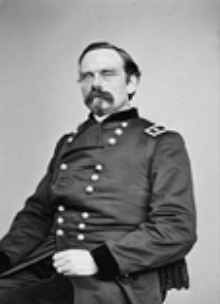
In 1903, it was announced that P.J. Osterhaus would return to the United States for a visit, and he quickly accepted an invitation by the Frank Blair Post #1 (Missouri Department of the Grand Army of the Republic), to attend the 1904 World’s Fair in St. Louis. Osterhaus was warmly greeted in New York City, who had honestly thought he was forgotten. Had dinner with President Theodore Roosevelt, and was introduced to members of Congress and the Supreme Court of the United States. He made a triumphant return to St. Louis on 7 May 1904; and a crowd of Grand Army veterans from St. Louis and surrounding areas (including a large contingent from the Hecker Post #443) were on hand for his reception. During his visit he stayed as a guest at the home of his former soldiers and friends, and due to his age, his appearances were scheduled between several days of rest.
On 10 May 1904; he met with the St. Louis veterans in the shadow of the Lyon monument, in the same spot where he had marched 43 years prior to capture Camp Jackson. That night Osterhaus returned to Belleville, by train as the guest of Colonel Casimir Andel. The Hecker Post (as well as other St. Clair County G.A.R. Posts) warmly greeted him with cordial welcomes and handshakes in the city square.
On the night of 13 May 1904; the City of Belleville held a public reception under the auspices of the Hecker Post & Women’s Relief Corps at Liederkranz Hall. “No greater crowd had assembled” there prior. The eldest grandson of Colonel Hugo Wangelin, Richard represented the Wangelin Family who gave him a beautiful bugle, as a gift. The Hecker Post G.A.R. Quartette provided the musical background as “Several outbursts of applause for the 81 year old General left him deeply moved by the residents of Belleville.” He departed for St. Louis on 16 May, for the Missouri G.A.R. Department’s 20th Annual Encampment, in Lexington, Missouri.
He spoke in St. Louis in July 1904; at a Sons of Veterans of the United States of America encampment about the Capture of Camp Jackson, Lyon’s Missouri Campaign, the Battle of Wilson’s Creek and of Lyon’s death.
On 18 July 1904; the Belleville City Council bestowed the honor onto him as “Honorary Citizen of the City of Belleville”. After a tour of the United States and visiting his family that stayed behind in the United States (including his son then Commander Hugo Osterhaus, who would later command the U.S. Navy’s Atlantic Fleet during World War One), he made a brief return to Belleville to rest at the Andel house, prior to going east and eventually back to Germany.
On 16 December 1904; a bill was introduced into the U.S. House of Representatives to place General Osterhaus on the U.S. Army’s retired list, which would raise his monthly pension. This bill was immediately endorsed by the National Grand Army of the Republic (including their Posts in Missouri and Illinois). While in Philadelphia, the General received the news that he was officially retired as a Brigadier General of the U.S. Army, effective 25 February 1905. The Senate confirmed his retirement on 15 March 1905. General Osterhaus, again traveled at special invitation of President Roosevelt to the White House, to be presented with the document retiring him as a Brigadier General of the regular Army; where the President remarked that his grandson Lt. Hugo W. Osterhaus; was a fine officer onboard his Presidential yacht “USS Mayflower”. By 1915; he was the oldest pensioner of the U.S. Civil War, he was also promoted on the regular army retired list to Major General.
The news of the death of his son Karl, who served in the German Army on 25 September 1904, impacted the General for many years. His son Ludwig moved to Belleville, and married the daughter of Casimir Andel, Josephine on about 7 September 1907. Joseph Osterhaus made a rather quiet return to the United States in 1906, to visit Ludwig, so quiet that the Belleville Advocate only made mention of it in one article. Hugo visited him in Duisburg, Germany; in 1911 & 1913. It was reported that he had a small apartment, that would resemble a small Civil War Museum, filled with one of a kind artifacts, and personal mementos. Some of these artifacts still exist.
Towards the end of his life, he supported Germany’s position in World War I, and of the Kaiser. He openly encouraged Hugo to use what clout he had for the United States to join the war against Great Britain; and for Ludwig to join the Army. He also made it clear, he didn’t have much respect for President Woodrow Wilson.
Major General Peter Joseph Osterhaus, United States Army; passed away at his residence of pneumonia, on 2 January 1917; in Koblenz, Germany. He was laid to rest there, however unfortunately, after two World Wars devastated Germany, his exact grave has been forever lost. (As of 2012; a movement was being made to place a marker in the area near where he is thought to have been laid to rest).
General Osterhaus spoke in a heavy german accent, and was not highly regarded for one reason or another, but his bilingual & tactical skills made him an asset to the Union cause during the war. Beloved by those who served under him and knew him, can attest to the character of the man. Following the Civil War, three Grand Army Posts were chartered honoring him: Post 485 in Prescott, Kansas; Post 101 in Hooper, Colorado and Post 399 in Nodaway, Missouri. A bust of him is located at the Vicksburg National Military Park. A one time resident of Belleville & Lebanon, Illinois; and St. Louis, Missouri; he was a leader within the German-American community of the 1850’s and an unsung hero among the German soldier, achieving much more than the famed General Fritz Sigel.
Sigel was unable or unwilling to deviate from the textbooks that he learned from in Prussia, while Osterhaus could adapt his tactics to the situation at hand. Osterhaus was a professional soldier, and only wanted to be recognized for his actions on the battlefield, where he was most at home. Sigel’s miscues and tantrums, most certainly caused promotions for Osterhaus to be held up and to have other officers look at Osterhaus in a different light. Other factors also worked against Osterhaus, as his immediate superior officers weren’t of the highest military grade (Fremont, Curtis, McClernand, & Hooker). When Osterhaus learned that Lincoln promoted him to gain political favor with the German voters, it went against everything he stood for and fought for on the battlefield, as a professional soldier asks no favors, he only does his duty.
Information From:
- “Yankee Warhorse: A biography of Major General Peter Osterhaus”
By: Mary Bobbitt Townsend
© 2010, The Curators of the University of Missouri
University of Missouri Press, Columbia, Missouri
- Belleville Advocate:
24 October 187926 May 1895 21 Jan 1904 5 May 1904 9 May 1904 10 May 1904 11 May 1904 14 May 1904 15 July 1904 19 July 1904
16 December 1904 24 February 1905 16 May 190514 August 1863
7 September 19071 May 185023 April 1851
- “Memoirs of Gustave Koerner: 1809-1896; Life Sketches written at the suggestion of his children”
By: Gustave Koerner
pp. 210, 397
Edited By: Thomas J. McCormick
© 1909; Mary K. Engelmann
Torch Press; Cedar Rapids, Iowa
http://archive.org/stream/memgustave02khorrich/memgustave02khorrich_djvu.txt
- Peter Joseph Osterhaus, Major General, U.S.V.
© 2009-2019 Mary B. Townsend
- Sons of Union Veterans of the Civil War
- Wikipedia
P.J. Osterhaus Chattanooga Campaign Atlanta Campaign Chickasaw BayouLookout Mountain Resaca Arkansas Post Missionary RidgeNew Hope Church
Vicksburg Ringgold’s Gap Battle of Dallas
Battle of AtlantaEzra’s Church Jonesborough
XV CorpsEdward S. Canby 12th Missouri Infantry
17th Missouri Infantry Battle of JacksonSpanish Fort
Port Gibson Big Black River Fort Blakely
Champion Hill Camp Jackson Affair Wilson’s Creek
Pea RidgeBooneville Griswoldville R.Admiral Hugo Osterhaus1876 Presidential Election
1880 Presidential Election Whitney’s Lane
Picture (Bottom of Article)
- Old-picture.com (Picture- Top of Article)
J. Stacy – Camp Historian
Col. F.K. Hecker Camp #443
Revision: 4
9 May, 2016
 heckercamp443