By Garry “Doc” Ladd, PCC
Colonel Hecker Camp #443
In recognition of Women’s History Month in March, as well as National Medal of Honor Day March 25, I thought of Dr. Mary Walker; the only female to receive the Medal of Honor to this date. Hers is one of my favorite stories from the Civil War.
Growing up in Oswego County, New York, I became familiar with Dr. Walker during talks at school and visits to the county seat in the city of Oswego. I can remember visiting the Richardson-Bates house in Oswego and seeing her original Medal of Honor on display.
The Richardson-Bates house is owned and operated as a historical museum by the Oswego County Historical Society. My knowledge of Dr. Walker was further supported during my freshman year in college when I attended Oswego State University in Oswego, New York. I walked by the medical center every day. The name of the medical center? The Mary Walker Medical Center. As my interest in Civil War medicine continues to grow, even now, I wanted to share her story during Women’s History Month.
Dr. Mary Edwards Walker was born Nov. 26, 1832 in Oswego County, New York. She was one of seven children born to Alvah and Vesta Walker. Mary attended the local school which her father built and of which her mother was the teacher.
Her father, Alvah, was in charge of the family farm and was also a carpenter. He was an abolitionist who believed in free thinking and supported many of the reform movements found in the
mid-1800s.
Mary’s parent’s influence and beliefs in reform, including education and equality for their daughters, molded the foundation for her at a young age and she showed these qualities throughout her life.
Since all of the daughters helped to work the farm, they were not restricted to wearing women’s clothing of the time, including corsets, as they were too restricting. Both parents wished for their children to become educated and pursue professional careers.
Medical School
Mary initially pursued a teaching profession graduating from the Falley Seminary in Fulton, New York, and began teaching in Minetto in 1852. In 1853 she enrolled in Syracuse Medical College located 35 miles from her home. Syracuse Medical College was the first medical school in the United States that equally accepted men and women.
Mary graduated from medical school in 1855 as the only female in her graduating class and only the second female physician in the country.
Civil War
Six years later at the outbreak of the Civil War, Mary went to Washington right after the Battle of Bull Run to join the Army as a medical officer. She was refused. Not being one to stop when barriers occur, she then volunteered as an acting assistant surgeon at the hospital that was positioned at the U.S. Patent Office in Washington. She was recommended for an Army commission by her supervisors, but never was commissioned during her stay there.
Not being commissioned in the Army had its advantages. One of which is that her movements were not restricted. She once accompanied a wounded soldier to his home in Rhode Island and also helped to organize the Women’s Relief Association. This was a great help in finding housing in Washington for the wives and children of wounded and recovering soldiers.
After the battle of Fredericksburg in December 1862, Dr. Walker worked as a field surgeon near the Union lines where she treated the wounded in a tent hospital. It is not clear whether she attempted or completed any amputations, but there are accounts of her encouraging soldiers to refuse them.
Her wish for a commission as a surgeon came closer to being fulfilled in September 1863 when she was appointed as a contract surgeon with the duties of assistant surgeon for the 52nd Ohio Infantry in the Army of the Cumberland. She wore an officer’s uniform, slightly modified, and carried two pistols.
In April 1864, Mary walked into a small band of Confederates in northern Georgia and was taken prisoner. She was imprisoned for four months at Castle Thunder Prison near Richmond. Complaining about the lack of grain and vegetables for the prisoners, she was able to convince her captors to add wheat bread and cabbage to the rations. She was eventually exchanged in August 1864 with 24 other Union surgeons for 17 Confederate doctors.
She continued her pursuit for an Army commission, and it eventually landed on President Lincoln’s desk, but it was still refused. Mary was finally granted an Army Commission in October 1864 as a U.S. Army assistant surgeon being paid at the rate of $100 each month. Subsequent to being the first female surgeon commissioned by the Army, she served six months at the Louisville Women’s Prison Hospital and eventually finished her wartime service at an orphan facility in Tennessee.
Dr. Mary Edwards Walker was eventually granted a discharge on June 15, 1865. She did receive a pension of $8.50 each month for an eye injury that was later increased to $20 in 1890.
Legacy
Upon the recommendation of Generals William T. Sherman and George H. Thomas, Dr. Mary Edwards Walker was awarded the Medal of Honor by President Andrew Johnson for Meritorious Service. Dr. Mary Edwards Walker was – and remains – the only woman ever to receive the Medal of Honor – the highest military award in the U.S.
Her citation included:
“…valuable service to the Government,” devoting, “herself with much patriotic zeal to the sick and wounded soldiers, both in the field and hospitals, to the detriment of her own health,” and enduring, “hardships as a prisoner of war.” The citation also stated that, “by reason of her not being a commissioned officer in the military service, a brevet or honorary rank cannot, under existing laws, be conferred upon her,” therefore, “in the opinion of the President, an honorable recognition of her services and sufferings should be made.” (Retrieved from https://www.womeninhistoryohio.com/mary-edwards-walker.html)
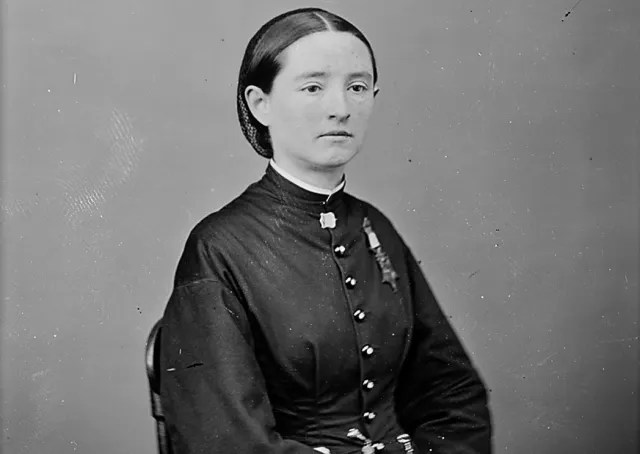
In 1917, Congress revised the standards for the awarding of the Medal of Honor to be granted only under actual combat with an enemy. This revision resulted in 911 medals being revoked, including Dr. Walker’s. However, she refused to give the medal back and is seen in most photos with the
medal pinned to her clothes. It is a crime to wear unauthorized medals, but she defiantly wore it until the day she died two years later.
The medal was finally restored by President Jimmy Carter on June 11, 1977 and is now on display at the Pentagon in the Women’s corridor. Dr. Walker died of natural causes on Feb. 21, 1919 and is buried in Oswego County, New York.


Leave a Reply