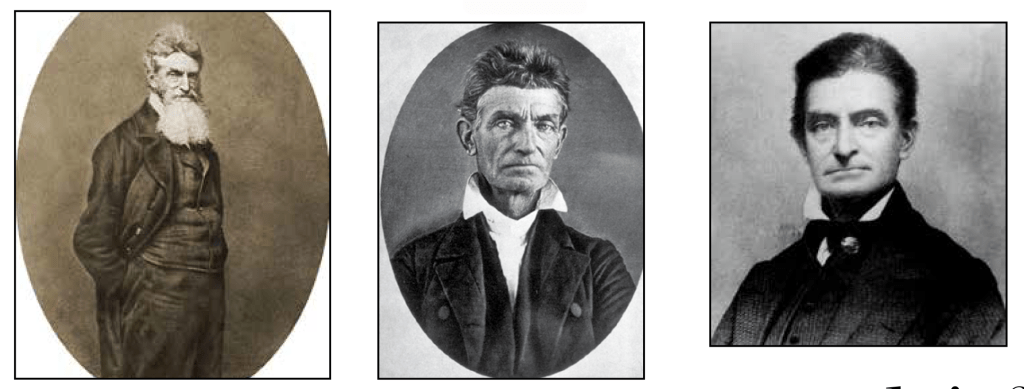
(Above) Images of John Brown. (Photo courtesy of U.S. Library of Congress)
By Richard Piper
Hecker Camp Treasurer, Patriotic Instructor
When the War of 1812 began, John Brown was 12 and started working with his father Owen Brown who was an Army beef contractor. John started his cattle drive to Michigan outposts through a forest trek of 100 miles, and at the end of each drive, John Brown would stay in the home of a U.S. Marshal where he was treated like family. He was given presents and was noted for his intelligence and speaking ability.
Owen Brown taught all his children to hate slavery. The Marshal had a slave about John’s age, and they became friends. One evening, the Marshal had friends over. After they left, the Marshal, unpleased with the slave boy’s dinner service, took an iron shovel from the
fireplace and beat the boy on the head and shoulders. The beating he witnessed
changed John Brown into the “most determined” enemy of slavery.
Brown’s rise
In 1849, Brown and his family moved to upstate New York. There, he assisted former slaves as new farmers on land that had been donated. Once the Kansas-Nebraska Act of 1854 was passed, he moved to Kansas, leaving his wife and youngest children at home.
In Kansas, he helped abolitionist settlers create a free soil state. There, he went to war against pro-slavery settlers and “border ruffians,” thus making him a fugitive in most of the country, but a hero among abolitionists.
As time passed, he felt he was not making enough progress to end slavery as “God’s chosen messenger” in the United States. He had a plan, though, that he thought would reach his goal.
Brown’s plan
On Oct. 16, 1859, John Brown and his provisional army of 18 soldiers marched toward Harpers Ferry, Virginia, which was located alongside the Potomac and Shenandoah Rivers. The town contained the second Federal armory of the nation. The first Federal armory has been located in Springfield, Massachusetts since 1777. Being centrally located and inland, the Harpers Ferry armory was safe from attacks from foreign navies, but not a good location in a civil war.
John Brown and his army, which included several relatives, would attack and seize the U.S. Armory and arsenal at Harpers Ferry and capture tens of thousands of firearms. The call for freedom would be sounded to nearby plantations. The slaves would rally to him and raid plantation after plantation. This army of slaves, he thought, would put pressure on the
Federal government, which was tolerant of slavery.
He hoped his crusade would make slavery economically unworkable and politically unpopular. His biggest hope was that his actions would create a revolution that would establish a new American government.
Harpers Ferry
When it was time to attack he cut the telegraph lines into Harpers Ferry and seized the covered railroad bridge across the Potomac and another bridge across the Shenandoah. They dispatched the only guard at the armory.
After that, his master plan then began to unravel. No great army of slaves appeared to help him. Instead, his army was being attacked by the angry citizens of the town who rose up to oppose him, causing casualties in Brown’s army.
The first to die was Dangerfield Newby; one of his five black soldiers. A train had been detained for a short time by Brown the morning of the raid. It later arrived at a station where a telegraph message alerted local militiamen who came to Harpers Ferry and forced a retreat by Brown’s men to a barricaded firehouse on the grounds of the armory.
Brown still had an ace up his sleeve in that he had taken the precaution of capturing dozens of prominent hostages including Lewis Washington, a slave owning great-grandnephew of President George Washington. He hoped that holding these men would buy him time for reinforcements to arrive. Reinforcements did arrive, but not for his side.
Help arrives
President James Buchanan sent a company of 86 Marines by special train from the Washington Navy Yard. They were placed under the command of Col. Robert E. Lee to stop the raid and arrest Brown and his army. Though the militia and Marines joined together, the militia was not gung ho to attack. The Marines were.
Army Lt. J.E.B. Stuart, home on leave from the West, joined the group. He showed a flag of truce and delivered a letter to Brown from Col. Lee demanding Brown’s surrender, which was refused.
The Marines then sprang into action. Sledgehammers and a ladder were used to storm through the barricaded door of the firehouse, and in the final skirmish one Marine was killed. However Brown, who was badly injured, was now in custody.
Aftermath
A quick trial was convened ten days after the raid on Oct. 26. Virginia Governor Henry Wise wanted the speedy trial for Brown and the other survivors under Virginia law. A conviction was reached Oct. 31, and Brown’s execution would take place Nov. 2. Virginia law mandated a one month delay, and on Dec. 2, John Brown was executed. One of the spectators at his execution was John Wilkes Booth.
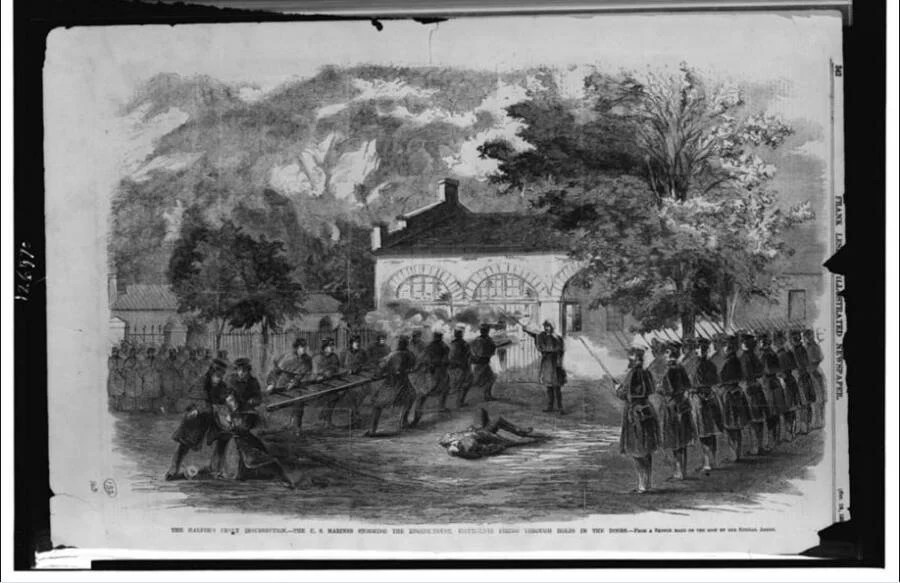
Marines attack the armory at Harpers Ferry. (National Archives)
In the end, the raid was a disaster. Of the 18 raiders, 10 died in the raid and six, plus John Brown, were executed. Brown’s family suffered a great loss. In addition to Brown, two of his sons and two brothers of his son-in-law were killed in the raid.
Although his actions are reported as a raid now, at that time, the term used was rebellion. The telegraph lines told of the “breaking” news of the day and his attempt to end slavery. Reverent death row interviews were printed in abolitionist newspapers. On the other
hand, pro-slavery newspapers had their editors portray John Brown as a villain and
a traitor, who showed what happened when you supported abolitionists.
His rebellion set the stage for Abraham Lincoln’s election in 1860 and 11 states
seceded shortly after to begin the Civil War. When Virginia seceded, Union soldiers
burned the armory at once. Harpers Ferry was also an important route to the South, and both the Union and Confederacy wanted it resulting in Harpers Ferry being captured and recaptured 14 times. Its railroad bridge connecting Maryland and Virginia was destroyed nine times.
Depending on your viewpoint, what happened at Harper’s Ferry makes John Brown a hero, a martyr or an abolitionist villain. A man with a burning passion to free the slaves certainly helped to ignite the passions that would explode into a war to make all people free.
Sources:
*Gaffney, Dennis and Peter (2011), The Civil War, page 21, Hyperion
*Letterjoy.co weekly newsletter


Leave a Reply